
Stockpicker / Ladder Cart Material Handling Carts and Trucks
Description
Stockpicker or Ladder Cart Material Handling Carts and Trucks are specialized mobile devices designed for transporting goods and materials. These carts typically feature integrated ladders, allowing users to safely reach higher shelves or storage areas while simultaneously managing the transportation of items. They are equipped with wheels for mobility and often include shelving or platforms to hold various loads.
Working Principle
The working principle of Stockpicker or Ladder Carts involves a combination of mobility and accessibility. These carts are designed to be easily maneuvered through narrow aisles and tight spaces, thanks to their compact and narrow design. The integrated ladder allows users to climb and access elevated storage areas safely, making them particularly useful in environments where vertical space is utilized. The carts often include features such as brakes for stability and safety during use, and some may have adjustable shelving to accommodate different load sizes.
Applications
Stockpicker or Ladder Carts are commonly used in warehouses, retail environments, and libraries where there is a need to access high shelves or storage areas. For example, in a retail setting, employees can use these carts to restock shelves efficiently. In libraries, they assist in organizing and retrieving books from higher shelves. They are also useful in manufacturing facilities for picking parts or components from storage racks.
Advantages over other Material Handling Carts and Trucks
One of the primary advantages of Stockpicker or Ladder Carts over other material handling carts is their ability to combine transportation and access in one unit. This dual functionality reduces the need for separate ladders or lifts, saving space and increasing efficiency. Their narrow design enhances mobility in confined spaces, which is a significant advantage in crowded or space-limited environments.
Limitations
Despite their advantages, Stockpicker or Ladder Carts have limitations. They may not be suitable for transporting very heavy loads due to weight restrictions. Additionally, the integrated ladder may not be as stable as a standalone ladder, potentially limiting the height that can be safely reached. These carts may also require more maintenance due to the additional moving parts associated with the ladder mechanism.
Considerations
When considering the purchase of Stockpicker or Ladder Carts, it is important to evaluate initial costs, which can be higher than standard carts due to their specialized design. Operating expenses may include regular maintenance to ensure the safety and functionality of the ladder mechanism. Durability is a key factor, as these carts need to withstand frequent use and potential impacts. Replacement and maintenance costs should also be considered, particularly for the ladder components, which may wear out faster than other parts of the cart.

from U.S. Plastic Corporation
Ladder carts provide greater mobility, enhanced access, safe ladder handling, and minimal storage requirements. Commercial-grade hybrid construction of powder-coated steel and Rubbermaid structural foam holds up to 500 pounds. Compact footprint increases maneuverability, requires minimal storage... [See More]
- Cart / Truck Type: Stockpicker
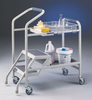
from Labconco Corporation
Stockroom Cart, a step ladder and cart in one. Features two removable, watertight, epoxy-coated steel pans with gray vinyl mats, and one vinyl-coated wire basket. Sturdy, two-step ladder with non-skid surface conforms to OSHA and ANSI design guidelines. Spring-loaded, oversized steps with... [See More]
- Cart / Truck Type: Platform Truck; Stockpicker
- Length: 35
- Capacity: 400
- Width: 19