
Anti-backlash Spur Gears
Description
Anti-backlash spur gears are designed to minimize or eliminate the backlash, which is the excess play or clearance between the meshing teeth of gears. This type of gear ensures more precise and accurate motion by reducing the space that can lead to inaccuracies in gear movement.
Working Principle
Anti-backlash spur gears work by incorporating a mechanism that compensates for the clearance between gear teeth. This is typically achieved through the use of spring-loaded or adjustable components that maintain constant contact between the gear teeth, thereby reducing or eliminating the backlash. This design is particularly useful in applications requiring high precision and accuracy, as it ensures smoother and more reliable gear operation.
Applications
Anti-backlash spur gears are commonly used in applications where precision is critical. Specific examples include robotics, where precise movement is essential for accurate positioning, and in CNC machinery, where exact gear positioning is necessary for precise cutting and shaping operations. They are also used in optical devices and instrumentation where even the slightest gear movement can affect the accuracy of the device.
Advantages over other Materials - Composites, Textiles and Reinforcements
While the documents do not provide specific comparisons between anti-backlash spur gears and materials like composites, textiles, and reinforcements, it is generally understood that metal gears, such as those used in anti-backlash designs, offer superior strength and durability compared to non-metallic materials. This makes them more suitable for high-load and high-precision applications where material deformation could compromise performance.
Limitations
One of the primary limitations of anti-backlash spur gears is their complexity compared to standard spur gears. The additional components required to reduce backlash can increase the cost and complexity of the gear system. Additionally, these gears may require more maintenance to ensure that the anti-backlash mechanism continues to function correctly over time.
Considerations
When considering anti-backlash spur gears, it is important to evaluate the initial costs, which may be higher due to the complexity of the design. Operating expenses can also be affected by the need for regular maintenance to ensure the anti-backlash mechanism remains effective. Durability is generally high, but the precision components may require more frequent inspection and adjustment. Accuracy is a key benefit, making these gears ideal for applications where precision is paramount. Replacement and maintenance costs should be factored into the overall cost of ownership, as these gears may require more attention than standard spur gears.
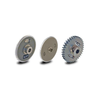
from Stock Drive Products & Sterling Instrument - SDP/SI
You May Also Need: Shafts. Bearings. Couplings. AGMA 10. .104 FACE. 1/8, 3/16 & 1/4 BORE. 20 ° PRESSURE ANGLE. MATERIAL: Gears. - 303 Stainless Steel 2024-T4 or. -T351 Aluminum Alloy, anodized before cutting. - Bronze QQ-B-637 Alloy 464. Hubs. - 303 Stainless Steel Springs. - 302 Stainless... [See More]
- Features: Anti-backlash
- Design: English
- Number of Teeth: 100
- Pressure Angle: 20°

from Ondrives.US Corporation, formerly Rino Mechanical
Ondrives.US has been designing, engineering, and manufacturing gears, gearboxes, and other motion transfer components for decades. If none of our standard gear options are right for your application, we can produce custom gears that meet your specifications. We can work from your part prints, or... [See More]
- Features: Anti-backlash
- Design: English; Metric
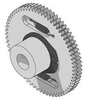
from TPA Motion
Precision gears are found in positioning and more specifically in closed loop feedback systems. Applications where coarse combined with fine measurements are critical typically use these gear sets. The anti-backlash gears eliminate play or lost motion in a mechanism caused by very small gaps between... [See More]
- Features: Anti-backlash
- Gear Center: Center Bore

from Ondrives.US Corporation, formerly Rino Mechanical
A gear is a rotating machine part that utilizes cut teeth, or cogs, to mesh with another toothed part —usually another gear or a linear toothed part (called a gear rack) —to transmit rotational motion and torque. By using a combination of precision gears with the correct ratio, the... [See More]
- Features: Anti-backlash
- Gear Center: Center Bore
- Design: English
- Pitch: Range: 1/20 to 120
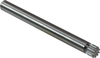
from Ondrives.US Corporation, formerly Rino Mechanical
A pinion gear is the smallest gear in a gear drive, and/or the drive gear in a gear reducer. A pinion shaft is a pinion gear machined directly onto a shaft. Ondrives.US designs, engineers, and manufactures pinion shafts in a range of sizes, pitches, and teeth counts. We have the right pinion shaft... [See More]
- Features: Anti-backlash
- Design: English
- Number of Teeth: 10 to 32
- Gear Center: Shaft