
High Velocity Oxy Fuel (HVOF) Thermal Spray Equipment
Description
High Velocity Oxy Fuel (HVOF) Thermal Spray Equipment is designed to produce dense, well-adhered coatings that are hardened, wear-resistant, and corrosion-resistant. This equipment utilizes a process that involves heating and accelerating powdered materials to create a coating with low porosity.
Working Principle
HVOF operates by using confined combustion and an extended nozzle to heat and accelerate powdered materials. The process involves combusting a fuel, such as hydrogen, propylene, or kerosene, with oxygen or air to create a hot, high-pressure gas stream. This gas stream propels the powder feedstock toward the part surface at hypersonic velocities. The impact of the partially melted particles with the surface at high velocity results in very dense coatings with superior bond strength. This method is particularly useful for creating coatings that require high wear resistance and some corrosion protection.
Applications
HVOF thermal spray equipment is typically used for applications requiring wear, heat, and corrosion resistance, as well as for dimensional restoration. Specific examples include the application of tungsten carbide coatings as an alternative to chrome plating on work rolls. The ExoGard family of coatings, such as ExoFilm and ExoShield, have been developed to offer better economics and performance compared to traditional high-velocity thermal spray processes.
Advantages over other Thermal Spray Equipment
HVOF produces coatings with lower porosity and higher adhesive and cohesive strength than those generally attainable with typical plasma spray processes. This results in superior wear resistance and corrosion protection. The high deposition rate and the ability to produce a very dense coating make HVOF advantageous for applications requiring thick coatings above 75 microns.
Limitations
One limitation of HVOF is the restriction on powder particle size and the requirement for a narrow size distribution. Additionally, HVOF is rarely carried out as a manual operation due to numerous process variables that affect coating consistency. The high surface roughness as deposited historically restricted its use as a chrome replacement at thinner coatings, although recent developments have addressed this issue.
Considerations
When considering HVOF thermal spray equipment, it is important to evaluate initial costs, operating expenses, and maintenance requirements. The equipment involves complex processes that may require significant investment in terms of setup and operation. Durability and accuracy of the coatings are generally high, but the need for precise control over process variables can impact operational costs. Replacement and maintenance costs should also be considered, as the equipment may require specialized components and expertise to maintain optimal performance.
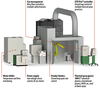
from Progressive Surface
Progressive Surface ™s next-generation Computer Integrated Thermal Spray (CITS) system is here. CITS Pro „ ¢ is the most advanced and flexible closed-loop thermal spray system available. We use the Procise Process ® to configure each CITS Pro „ ¢ system... [See More]
- Type: Plasma Spray; HVOF; Electric Arc; Wire Flame Spray
- Automation / Control: Automatic
- Equipment Type: Complete System