
USB Type B Network Cables
Last Updated: February 12, 2025
Description
USB Type B network cables are designed to connect devices such as printers, scanners, and other peripherals to a computer or network. These cables typically feature a USB Type B connector on one end, which is square-shaped with slightly beveled corners, and a USB Type A connector on the other end, which is flat and rectangular. The primary function of these cables is to facilitate data transfer and communication between devices.
Working Principle
USB Type B cables operate by transmitting data through a universal serial bus (USB) interface, which standardizes the connection between computers and peripheral devices. The USB standard allows for plug-and-play functionality, meaning devices can be connected and disconnected without the need to restart the computer. This is achieved through a combination of hardware and software protocols that manage data transfer rates and power supply to connected devices. USB Type B cables are particularly useful because they support a wide range of data transfer speeds, depending on the USB version, and provide a reliable connection for various peripherals.
Applications
USB Type B cables are commonly used in a variety of applications. For example, they are frequently employed to connect printers and scanners to computers in both home and office environments. In industrial settings, these cables can be used to connect industrial I/O devices to computers, facilitating data collection and control processes. Additionally, they are used in audio and video applications to connect devices such as audio interfaces and external hard drives.
Advantages over other Network Cables
One of the main advantages of USB Type B cables over other network cables is their widespread compatibility with a variety of devices and operating systems. Unlike some proprietary cables, USB Type B cables can be used with many different brands and types of equipment. They also offer the convenience of plug-and-play functionality, which simplifies the process of connecting and disconnecting devices. Furthermore, USB cables generally provide sufficient power to operate connected devices, eliminating the need for additional power sources in many cases.
Limitations
USB Type B cables have some limitations, including a maximum cable length of 5 meters for full-speed devices and 3 meters for low-speed devices, as specified by the USB standard. This can restrict their use in environments where longer cable runs are necessary. Additionally, while USB Type B cables are suitable for many applications, they may not support the high data transfer rates required for certain high-performance tasks, such as video editing or large-scale data backups.
Considerations
When selecting USB Type B cables, it is important to consider factors such as initial costs, operating expenses, and durability. USB cables are generally affordable, but prices can vary based on length and quality. Operating expenses are typically low, as USB cables do not require additional power sources. Durability can be a concern, especially in harsh environments, so it may be necessary to choose cables with reinforced connectors or shielding. Additionally, while USB cables are generally reliable, they may require replacement over time due to wear and tear, so it is advisable to keep spare cables on hand to minimize downtime.
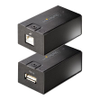
from RS Components, Ltd.
USB 2.0 Extender Over Cat5e/Cat6, 492ft [See More]
- Connector Type: RJ-45; USBB; USB B
- Product Type: USB
- Product Category: Cable Assembly
- Cable Type: Cat 5; Cat 6

from Cicoil Corporation
USB 2.0 and 3.0 Available. Ideal for High Performance Data Transmission Applications. Ultra Flexible Cable for Confined Area and Continuous Motion [See More]
- Connector Type: USBA; USBB
- Product Type: Serial; USB
- Product Category: Cable (optional feature); Cable Assembly
- Cable Type: Flat Cable