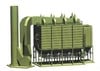
Products/Services for Afterburner Catalytic Oxidizer
-
 Thermal Oxidizers and Catalytic Oxidizers - (202 companies)Thermal oxidizers and catalytic oxidizers are used to destroy volatile organic compounds (VOC) in process gases. Thermal oxidizers may also be called afterburners or direct flame thermal oxidizers. Thermal oxidation is a method of pollution control...Oxidizer TypeDestruction Efficiency / Capability
 -
 Selective Catalytic Reduction (SCR) Systems - (72 companies)...catalytic reducers (SCR) work in a manner similar to the way a catalytic converter works to reduce automobile emissions. Catalytic converters circulate un-oxidized portions of the exhaust stream in an oxidizing environment to break down additional...
 -
 Oxidation Equipment - (55 companies)Oxidation equipment sterilizes wastewater via oxidative chemical processes. Oxidation equipment refers to the mechanisms and devices that chemically treat water via oxidation. Strong chemical oxidizers are introduced into supplies of wastewater...
 -
 Incinerators - (70 companies)Incinerators are used for burning organic material, gases, fumes, hazardous waste, and municipal trash or sewage sludge at a high temperature, sometimes to produce energy.
 -
 Catalysts and Initiators - (354 companies)Catalysts are useful because the alternate pathways typically use less energy than it would take to activate an uncatalyzed reaction. Catalytic action can also make it possible to perform chemical processes at lower temperature and/or pressure, thereby...
 -
Biocides - (146 companies)...ingredients. Some of the oxidizing biocides are simple solutions of common chemicals like bleach. End users can purchase these products, as well as chlorine gas, directly from the manufacturer. The second tier of the industry is made up of biocide suppliers...
-
Catalyst Supports and Carriers - (35 companies)...and carriers serve as media for the delivery of catalytic substances to aid chemical process. This is achieved by coating the components with the substance, which in turn increases the number of catalytic sites available. They facilitate the reaction...
-
Gas Sensors - (601 companies)Gas sensors interact with a gas to initiate the measurement of its concentration. The sensor then provides output to an instrument to display the measurements.
-
Total Organic Carbon (TOC) Analyzers - (63 companies)...the blank value is very low as long as the reagents are pure, which makes the analysis more accurate. Ultraviolet irradiation uses ultra-violet light to oxidize the carbon present in the sample to produce carbon dioxide. UV oxidation is the most...
-
Ovens (industrial) - (487 companies)...and maintenance of Class A, B, C, and D ovens, dryers, and furnaces, thermal oxidizers, and any other heated enclosure used for processing of materials and related equipment. Provisions are also provided for furnace heating systems, safety...
Product News
-
 Control Instruments Corp.
Top 3 Reasons to Use PrevEx to Monitor Oxidizers Thermal oxidizers are used to destroy the VOC's present in many industrial ventilation, process exhaust and waste air streams. As their use increases, so does a unique opportunity. BE SAFE. SAVE ENERGY. LOWER FUEL COSTS. The PrevEx is our flammability analyzer for lower flammable limit monitoring (LFL/LEL). Download Control Instruments' new infographic and learn the top 3 reasons to use the PrevEx on oxidizers. Visit our website to find out how we can help you select the safest, most... (read more)Browse Gas Instruments Datasheets for Control Instruments Corp. -
High Performance Alloys, Inc.
High Temperature Alloys High temperature resistance is essential in many applications. Gas turbines, fuel nozzles, heat treating fixtures, and furnace baffles. These materials must stand up to high heat, extreme oxidation potential and cycling. HASTELLOY (R) alloy X (HX). (UNS N06002) Ni 47.5, Cr 21.8, Fe 18.5, Mo 9.0. Excellent high temperature strength and oxidation resistance to 2200 F. Excellent forming and welding characteristics. Resistance to oxidizing, reducing, and neutral atmospheres. Resistant to SCC... (read more)Browse Specialty Nonferrous Metals and Alloys Datasheets for High Performance Alloys, Inc. -
High Performance Alloys, Inc.
Corrosion Resistant Alloys Corrosion Resistant Alloys. HASTELLOY (R) alloy C-276. (UNS N10276) Ni 57.0, Mo 16.0, Cr 15.5, Fe 5.5, W 3.8. Outstanding corrosion resistance in reducing and oxidizing environments. Maintains corrosion resistance in welded condition. Excellent resistance to pitting and stress-corrosion cracking (SCC). Widely used in severest environments in chemical processing, pollution control, pulp and paper. HASTELLOY (R) alloy B-2. (UNS N10665) Ni 68, Mo 28, Fe 2, Co 1, Cr 1. Significant resistance... (read more)Browse Superalloys Datasheets for High Performance Alloys, Inc. -
DOD Technologies Inc.
Portable Gas Detection for Semiconductor Safety include - (1) ambient air, (2) gas cabinets, (3) valve manifold boxes, (4) gas storage. Alternate locations include tool-specific valve boxes, hydrogen distribution boxes, vacuum pump enclosures, and abatement systems. Toxic gases typically found in the semiconductor industry include hydrides, mineral acids, oxidizers (such as chlorine & fluorine), and ammonia. Our signature line of ChemLogic (R) fixed gas detectors provides the fastest-responding, most reliable form of detection... (read more)Browse Gas Instruments Datasheets for DOD Technologies Inc. -
Ducon Environmental Systems
Refinery Magic: Turning Heavy Oil into Gasoline! Fluid Catalytic Cracking (FCC). Fluid Catalytic Cracking (FCC) is one of the most important refinery processes as it converts high-boiling, high-molecular weight hydrocarbon fractions of petroleum crude oils to more valuable gasoline, olefinic gases, and other products. Residue fluid catalytic cracking is the primary technology to upgrade to light products from heavy feed stocks. To ensure oil refineries work efficiently with reduced operating costs and remain competitive our expertise... (read more)Browse Selective Catalytic Reduction (SCR) Systems Datasheets for Ducon Environmental Systems -
Control Instruments Corp.
Monitor Flammability of batch oven exhaust streams A company that develops and produces generic drugs such as ear drops, scalp & body oils, liquid syrup, oral solids, nasal sprays & more chose Control Instruments' PrevEx Flammability Analyzers over IR sensors to monitor the flammability of the batch oven exhaust streams going into the oxidizer. The Process. The pharmaceutical process involves coating products with a mixture of solvents (IPA, ethanol & acetate) and then heating them in batch ovens. The solvents evaporate off in the heating... (read more)Browse Gas Instruments Datasheets for Control Instruments Corp. -
Acme Engineering Products
UNISET Gas Monitor - Building Ventilation Control Single-zone gas detection for toxic and combustible gases using electrochemical and catalytic bead sensor technology. UNISET is a single-point stand-alone gas monitor for a number of toxic and flammable gases as well as oxygen deficiency. It utilizes state-of-the art sensor technology: electrochemical for toxic gases and oxygen; catalytic bead for combustibles. The UNISET has up to four SPDT relay outputs fully user-configurable to operate at different thresholds and time delays. It also... (read more)Browse Gas Sensors Datasheets for Acme Engineering Products -
Ducon Environmental Systems
Product recovery in the Oil Refinery Industry Ducon High-Efficiency Cyclones are used for product recovery in the Oil Refinery and Petro Chemical Industries. Applications. Fluid Catalytic Cracking (FCC). High- Boiling hydrocarbon fractions of petroleum crude oils. High-molecular weight hydrocarbon fractions of petroleum crude oils. Spray Drying, Calcining. Ore Roasting, Aggregate. Minerals, Materials Conveying System (read more)Browse Cyclone Separators Datasheets for Ducon Environmental Systems -
Ducon Environmental Systems
Regenerator Cyclone and FCC Reactor Fluid Catalytic Cracking (FCC) is one of the most important refinery processes as it converts high-boiling, high-molecular weight hydrocarbon fractions of petroleum crude oils to more valuable gasoline, olefinic gases, and other products. Residue fluid catalytic cracking is the primary technology to upgrade to light products from heavy feed stocks. To ensure oil refineries work efficiently with reduced operating costs and remain competitive our expertise in designing highly efficient RFCC... (read more)Browse Cyclone Separators Datasheets for Ducon Environmental Systems -
Ducon Environmental Systems
Unlock Crucial FCC Cyclone Insights Now! Cyclone Separator: Fluid Catalytic Cracking, FCC is one of the most important refinery processes as it converts high-boiling, high-molecular weight hydrocarbon fractions of petroleum crude oils to more valuable gasoline, olefinic gases, and other valuable products. Residue fluid catalytic cracking RFCC is used for upgrading heavy feedstocks to light products. Therefore, a properly designed and highly efficient FCC and RFCC cyclone system is extremely important to ensure refineries operate... (read more)Browse Cyclone Separators Datasheets for Ducon Environmental Systems
More Information
 Indicates content that may require registration and/or purchase.

-
Advances in Environmental Geotechnics
The units can also be afterburners or catalytic oxidizers that completely destroy the organic contaminants.
-
Choosing VOC control technology.
Aspects considered include: factors involved in the selection of VOC containment equipment; processes and equipment available for control or destruction of VOC (adsorption, biofiltration, thermal oxidation, direct flame afterburner , catalytic oxidizer , recuperative oxidizer, regenerative thermal oxidizer, UV light oxidation, wet scrubbing); and …
-
Assessment of Hybrid Configuration and Control Strategies in Planning Future metropolitan/Urban Transit Systems
Recent advances in diesel combustion technologies, better afterburners and catalytic oxidizers , and use of alternative fuels such as compressed natural gas (CNG), propane, and methanol have resulted in overall reduction in the emission of particulate matters (PM) and other gaseous emissions such …
-
States > Michigan > State > Forms > Department of Environmental Quality > [MI FORM generalpermitprogram] Permit to Install for Diesel Fuel Fired Generators wit...
granular activated carbon unit, a thermal oxidizer (incinerator or afterburner ), a catalytic oxidizer (incinerator), an internal combustion engine, or a biofilter in combination with one of the other listed controls.
-
States > Michigan > State > Forms > Department of Environmental Quality > [MI FORM remedjan03] General Permit to Install for Remediation Processes: Gasoline an...
… tons per year and/or total potential BTEX emissions greater than 1 ton per year must install one or more of the following emission controls: a single or dual stage granular activated carbon unit, a thermal oxidizer (incinerator or afterburner ), a catalytic oxidizer .
-
States > California > State > Air Districts > South Coast > Regulation III - Fees > [sc AQMD 301] Rule 301 - Permitting and Associated Fees
Afterburner / Oxidizer , Catalytic .
-
States > California > State > Air Districts > South Coast > Regulation XI - Source Specific Standards > [sc AQMD 1147] Rule 1147 - NOx Reductions From Miscella...
Afterburner , degassing unit, catalytic oxidizer , thermal oxidizer, vapor incinerator, evaporator, food oven, fryer, heated process tank, parts washer or spray booth make-up air heater manufactured prior to 1998 .
-
States > California > State > Air Districts > Ventura County > Regulation IV - Prohibitions > [ven AQMD 74-15-1] Rule 74-15-1 - Boilers‚ Steam Generators...
Afterburner , vapor incinerator, or thermal or catalytic oxidizers used as an emission control device.
-
Assessment of Industrial VOC Gas-Scrubber Performance
Schematics of various volatile organic compound air pollution techniques: (1) Afterburner , (2) Recuperative thermal oxidizer , (3) Regenerative thermal oxidizer, (4) Flare, (5) Catalytic Oxidizer, (6) Biofilter [from Ref. 10] .
-
Pollutant Diseases, Remediation and Recycling
This technique is normally coupled with a post treatment-destruction technology such as an after- burner , a catalytic oxidation chamber, a carbon adsorption unit or a condenser to subsequently treat any volatile component or toxic emission emanating from the soil, prior to … Afterburners and oxidisers ensure com- plete destruction of the organic compounds while the carbon adsorption units and …