
KVA Meters Information
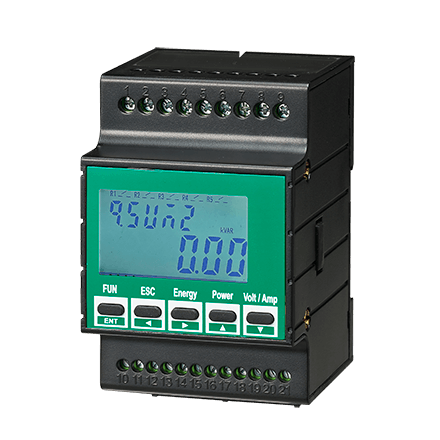 KVA meters measure the apparent power of AC devices in kilovolt-amperes (KVA). Apparent power is the combination of a circuit’s true power and reactive power. True power is the actual power dissipated in a circuit. Reactive power or imaginary power indicates how a reactive load drops voltage and draws current, but does not actually dissipate power.
Options
Options to consider:
- bandwidth
- sampling rate
- maximum channels
- operating temperature
Bandwidth is the frequency range for AC current or voltage to be measured. Sampling rate is the frequency that a digital meter tests an analog signal and converts to a digital value. Maximum channels for KVA meters range from 2 to 24. Operating temperature is expressed as a range.
Features
Standards, options, and features are important parameters to consider when specifying KVA meters. Some products have an adjustable sampling rate, alarm lights, auto-ranging capabilities, and integral application software. Others feature data acquisition, data storage or logging, decibel reading, and external triggering capabilities. External shunts can be used to extend the current input range. Integrating functions allow the active power and current to be integrated. Mirrored scales facilitate readings to a given accuracy and help operators avoid parallax errors. Range switches can be used to select the range of units to measure. KVA meters with overload protection, filters, scaling functions, and temperature compensation are also available.
Types
KVA meters come in several different form factors. Benchtop meters are designed to sit atop a bench or tabletop. Free-standing devices have a full case or cabinet and an integral interface. KVA meters that function as clamp meters measure current through wires that are connected to the circuit. Rack-mounted devices include hardware such as rail guides, flanges, and tabs. They are designed for mounting in telecommunications racks. Handheld KVA meters are relatively lightweight and can be operated while held in the hand. Products with a computer-board form factor are printed circuit boards (PCBs) that plug into computer motherboards or backplanes. KVA meters with other form factors are also available.
Specifications
Output options, display type, and approvals are additional considerations when selecting KVA meters. Common output options include binary coded decimal (BCD), digital-to-analog (D/A), universal serial bus (USB), general-purpose interface bus (GPIB), and RS-232. Display types are designated as analog or digital.
Standards
In terms of approvals, some KVA meters bear quality marks or comply with published standards for performance and safety. In Europe, products that bear the CE mark comply with European Union (EU) directives such as Restriction of Hazardous Substances (RoHS) and Waste Electrical and Electronics Equipment Regulations (WEEE). KVA meters that bear the CSA mark from the Canadian Standards Association (CSA) are also available.
Related Information
CR4 Community—Problem In Parallel Operation of Transformers
CR4 Community—How Do I Improve My Power Factor?
Engineering360—Single Phase Transformers Information