 Preface
Diffraction and imaging are central topics in many modern and scientific
fields. Fourier analysis and sythesis techniques are a unifying theme
throughout this subject matter. For example, many modern imaging
techniques have evolved through research and development with the
Fourier methods.
This textbook has its origins in courses, research, and development
projects spanning a period of more than 30 years. It was a pleasant experience to observe
over the years how the topics relevant to this book evolved and became more
significant as the technology progressed. The topics involved are many and are highly
multidisciplinary.
Even though Fourier theory is central to understanding, it needs to be supplemented
with many other topics such as linear system theory, optimization, numerical methods,
imaging theory, and signal and image processing. The implementation issues and
materials of fabrication also need to be coupled with the theory. Consequently, it is
difficult to characterize this field in simple terms. Increasingly, progress in technology
makes it of central significance, resulting in a need to introduce courses, which cover
the major topics together of both science and technology. There is also a need to help
students understand the significance of such courses to prepare for modern technology.
This book can be used as a textbook in courses emphasizing a number of the
topics involved at both senior and graduate levels. There is room for designing
several one-quarter or one-semester courses based on the topics covered.
The book consists of 20 chapters and three appendices. The first three chapters
can be considered introductory discussions of the fundamentals. Chapter 1 gives a
brief introduction to the topics of diffraction, Fourier optics and imaging, with
examples on the emerging techniques in modern technology.
Chapter 2 is a summary of the theory of linear systems and transforms needed in
the rest of the book. The continous-space Fourier transform, the real Fourier
transform and their properties are described, including a number of examples. Other
topics involved are covered in the appendices: the impulse function in Appendix A,
linear vector spaces in Appendix B, the discrete-time Fourier transform, the discrete
Fourier transform, and the fast Fourier transform (FFT) in Appendix C.
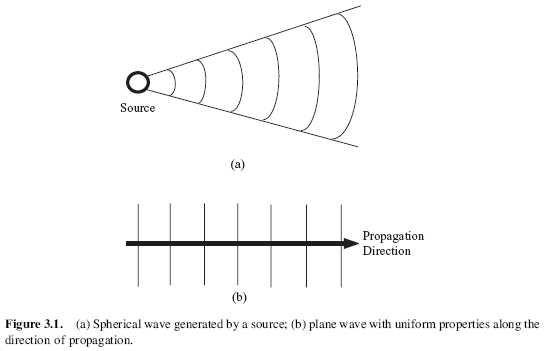
Chapter 3 is on fundamentals of wave propagation. Initially waves are described
generally, covering all types of waves. Then, the chapter specializes into
electromagnetic waves and their properties, with special emphasis on plane waves.
The next four chapters are fundamental to scalar diffraction theory. Chapter 4
introduces the Helmholtz equation, the angular spectrum of plane waves, the
Fresnel-Kirchoff and Rayleigh-Sommerfeld theories of diffraction. They represent
wave propagation as a linear integral transformation closely related to the Fourier
transform.
Chapter 5 discusses the Fresnel and Fraunhofer approximations that allow
diffraction to be expressed in terms of the Fourier transform. As a special application
area for these approximations, diffraction gratings with many uses are described.
Diffraction is usually discussed in terms of forward wave propagation. Inverse
diffraction covered in Chapter 6 is the opposite, involving inverse wave propagation.
It is important in certain types of imaging as well as in iterative methods of
optimization used in the design of optical elements. In this chapter, the emphasis is
on the inversion of the Fresnel, Fraunhofer, and angular spectrum representations.
The methods discussed so far are typically valid for wave propagation near the z-
axis, the direction of propagation. In other words, they are accurate for wave
propagation directions at small angles with the z-axis. The Fresnel and Fraunhofer
approximations are also not valid at very close distances to the diffraction plane.
These problems are reduced to a large extent with a new method discussed in
Chapter 7. It is called the near and far field approximation (NFFA) method. It
involves two major topics: the first one is the inclusion of terms higher than second
order in the Taylor series expansion; the second one is the derivation of equations to
determine the semi-irregular sampling point positions at the output plane so that the
FFT can still be used for the computation of wave propagation. Thus, the NFFA
method is fast and valid for wide-angle, near and far field wave propagation
applications.
When the diffracting apertures are much larger than the wavelength, geometrical
optics discussed in Chapter 8 can be used. Lens design is often done by using
geometric optics. In this chapter, the rays and how they propagate are described with
equations for both thin and thick lenses. The relationship to waves is also addressed.
Imaging with lenses is the most classical type of imaging. Chapters 9 and 10 are
reserved to this topic in homogeneous media, characterizing such imaging as a linear
system. Chapter 9 discusses imaging with coherent light in terms of the 2-D Fourier
transform. Two important applications, phase contrast microscopy and scanning
confocal microscopy, are described to illustrate how the theory is used in practice.
Chapter 10 is the continuation of Chapter 9 to the case of quasimonochromatic
waves. Coherent imaging and incoherent imaging are explained. The theoretical
basis involving the Hilbert transform and the analytic signal is covered in detail.
Optical aberrations and their evaluation with Zernike polynomials are also
described.
The emphasis to this point is on the theory. The implementation issues are
introduced in Chapter 11. There are many methods of implementation. Two major
ones are illustrated in this chapter, namely, photographic films and plates and
electron-beam lithography for diffractive optics.
In Chapters 9 and 10, the medium of propagation is assumed to be homogeneous
(constant index of refraction). Chapter 12 discusses wave propagation in
inhomogeneous media. Then, wave propagation becomes more difficult to compute
numerically. The Helmholtz equation and the paraxial wave equation are
generalized to inhomogeneous media. The beam propagation method (BPM) is
introduced as a powerful numerical method for computing wave propagation in
inhomogenous media. The theory is illustrated with the application of a directional
coupler that allows light energy to be transferred from one waveguide to another.
Holography as the most significant 3-D imaging technique is the topic of Chapter
13. The most basic types of holographic methods including analysis of holographic
imaging, magnification, and aberrations are described in this chapter.
In succeeding chapters, diffractive optical elements (DOEs), new modes of
imaging, and diffraction in the subwavelength scale are considered, with extensive
emphasis on numerical methods of computation. These topics are also related to
signal/image processing and iterative optimization techniques discussed in Chapter
14. These techniques are also significant for the topics of previous chapters,
especially when optical images are further processed digitally.
The next two chapters are devoted to diffractive optics, which is creation of
holograms, more commonly called DOEs, in a digital computer, followed by a
recording system to create the DOE physically. Generation of a DOE under
implementational constraints involves coding of amplitude and phase of an
incoming wave, a topic borrowed from communication engineering. There are many
such methods. Chapter 15 starts with Lohmann’s method, which is the first such
method historically. This is followed by two methods, which are useful in a variety
of waves such as 3-D image generation, and a method called one-image-only
holography, which is capable of generating only the desired image while suppressing
the harmonic images due to sampling and nonlinear coding of amplitude and phase.
The final section of the chapter is on the binary Fresnel zone plate, which is a DOE
acting as a flat lens.
Chapter 16 is a continuation of Chapter 15, and covers new methods of coding
DOEs and their further refinements. The method of projections onto convex sets
(POCS) discussed in Chapter 14 is used in several ways for this purpose. The
methods discussed are virtual holography, which makes implementation easier,
iterative interlacing technique (IIT), which makes use of POCS for optimizing a
number of subholograms, the ODIFIIT, which is a further refinement of IIT by
making use of the decimation-in-frequency property of the FFT, and the hybrid
Lohmann–ODIFIIT method, resulting in considerably higher accuracy.
Chapters 17 and 18 are on computerized imaging techniques. The first such
technique is synthetic aperture radar (SAR) covered in Chapter 17. In a number of
ways, a raw SAR image is similar to the image of a DOE. Only further processing,
perhaps more appropriately called decoding, results in a reconstructed image of a
terrain of the earth. The images generated are very useful in remote sensing of the
earth. The principles involved are optical and diffractive, such as the use of the
Fresnel approximation.
In the second part of computerized imaging, computed tomography (CT) is
covered in Chapter 18. The theoretical basis for CT is the Radon transform, a cousin
of the Fourier transform. The projection slice theorem shows how the 1-D Fourier
transforms of projections are used to generate slices of the image spectrum in the 2-
D Fourier transform plane. CT is highly numerical, as evidenced by a number of
algorithms for image reconstruction in the rest of the chapter.
Optical Fourier techniques have become very important in optical communications
and networking. One such area covered in Chapter 19 is arrayed waveguide
gratings (AWGs) used in dense wavelength division multiplexing (DWDM). AWG
is also called phased array (PHASAR). It is an imaging device in which an array of
waveguides are used. The waveguides are different in length by an integer m times
the central wavelength so that a large phase difference is achieved from one
waveguide to the next. The integer m is quite large, such as 30, and is responsible for
the large resolution capability of the phasar device, meaning that the small changes
in wavelength can be resolved in the output plane. This is the reason why
waveguides are used rather than free space. However, it is diffraction that is used
past the waveguides to generate images of points at different wavelengths at the
output plane. This is similar to a DOE, which is a sampled device. Hence, the images
repeat at certain intervals. This limits the number of wavelengths that can be imaged
without interference from other wavelengths. A method called irregularly sampled
zero-crossings (MISZCs) is discussed to avoid this problem. The MISZC has its
origin in one-image-only holography discussed in Chapter 15.
Scalar diffraction theory becomes less accurate when the sizes of the diffracting
apertures are smaller than the wavelength of the incident wave. Then, the Maxwell
equations need to be solved by numerical methods. Some emerging approaches for
this purpose are based on the method of finite differences, the Fourier modal
analysis, and the method of finite elements. The first two approaches are discussed in
Chapter 20. First, the paraxial BPM method discussed in Section 12.4 is
reformulated in terms of finite differences using the Crank-Nicholson method.
Next, the wide-angle BPM using the Pade approximation is discussed. The final
sections highlight the finite difference time domain and the Fourier modal method.
Many colleagues, secretaries, friends, and students across the globe have been
helpful toward the preparation of this manuscript. I am especially grateful to them
for keeping me motivated under all circumstances for a lifetime. I am also very
fortunate to have worked with John Wiley & Sons, on this project. They have been
amazingly patient with me. Without such patience, I would not have been able to
finish the project. Special thanks to George Telecki, the editor, for his patience and
support throughout the project.
 TABLE OF CONTENTS