|
 INTRODUCTION
 TABLE OF CONTENTS
 Chapter 9.4 - Fixed-Interval Smoothing
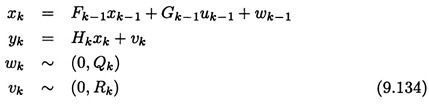
9.4 FIXED-INTERVAL SMOOTHINGSuppose we have measurements for a fixed time interval. In fixed-interval smoothing we seek an estimate of the state at some of the interior points of the time interval. During the smoothing process we do not obtain any new measurements. Section 9.4.1 discusses the forward-backward approach to smoothing, which is perhaps the most straightforward smoothing algorithm. Section 9.4.2 discusses the RTS smoother, which is conceptually more difficult but is computationally cheaper than forward-backward smoothing. 9.4.1 Forward-backward smoothing Suppose we want to estimate the state xmbased on measurements from k = 1 to k = N, where N > m. The forward-backward approach to smoothing obtains two estimates of xm. The first estimate, Suppose that we combine a forward estimate  where Kf and Kb are constant matrix coefficients to be determined. Note that  The covariance of the estimate can then be found as 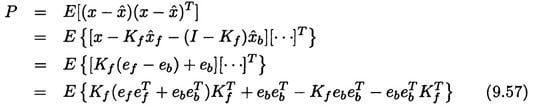 where ef = x - xf , eb = x - xb, and we have used the fact that  where Pf =  The inverse of (Pf + Pb) always exists since both covariance matrices are positive definite. We can substitute this result into Equation (9.57) to find the covariance of the fixed-interval smoother as follows:  Using the identity (A + B) -1 = B - 1(AB -1 + I) -1 (see Problem 9.2), we can write the above equation as  Multiplying out the first term, and again using the identity (A + B) -1 = B - 1(AB -1 + I) -1on the last two terms, results in  From the matrix inversion lemma of Equation (1.39) we see that  Substituting this into Equation (9.62) gives 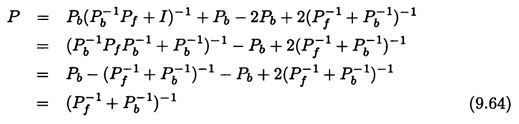 These results form the basis for the fixed-interval smoothing problem. The system model is given as 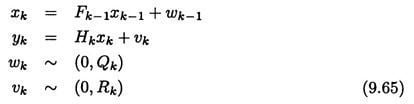 Suppose we want a smoothed estimate at time index m. First we run the forward Kalman filter normally, using measurements up to and including time m.
 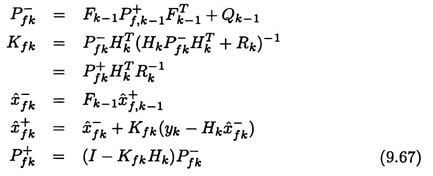 At this point we have a forward estimate for xm, along with its covariance. These quantities are obtained using measurements up to and including time m. The backward filter needs to run backward in time, starting at the final time index N. Since the forward and backward estimates must be independent, none of the information that was used in the forward filter is allowed to be used in the backward filter. Therefore,
We are using the minus superscript on Now the question arises how to initialize the backward state estimate  A minus or plus superscript can be added on all the quantities in the above equation to indicate values before or after the measurement at time k is taken into account. Since  The infinite boundary condition on 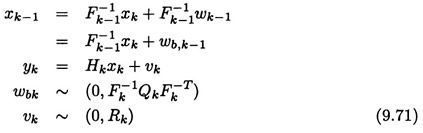 Note that
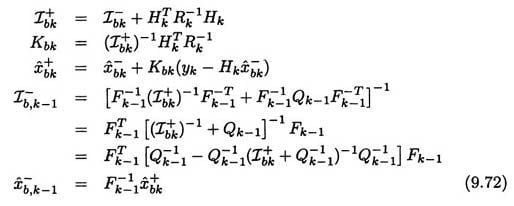 The first form for The third form for Since we need to update sk =  Now note from Equation (6.33) that we can write
We combine this with Equation (9.72) to write the backward information filter as follows.
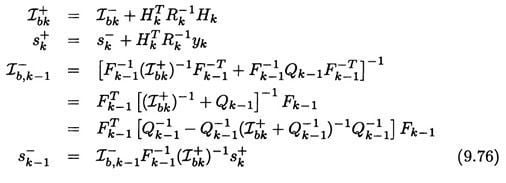 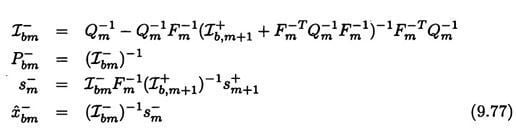 Now we have the backward estimate After we obtain the backward quantities as outlined above, we combine them with the forward quantities from Equation (9.67) to obtain the final state estimate and covariance: 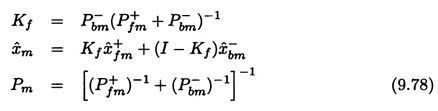 We can obtain an alternative equation for  Using the matrix inversion lemma on the rightmost inverse in the above equation and performing some other manipulations gives 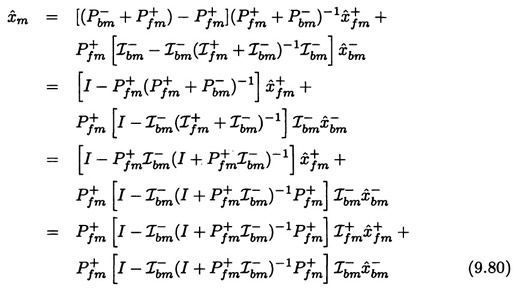 where we have relied on the identity(A + B) -1 = B - 1(AB -1 + I) -1 (see Problem 9.2). The coefficients of 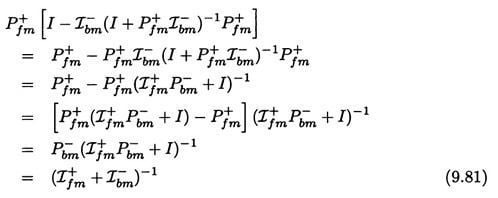 Therefore, using Equation (9.78), we can write Equation (9.80) as  Figure 9.9 illustrates how the forward-backward smoother works. 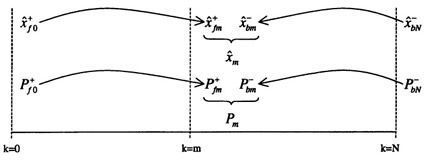 Figure 9.9 This figure illustrates the concept of the forward-backward smoother. The forward filter is run to obtain a posteriori estimates and covariances up to time m. Then the backward filter is run to obtain a priori estimates and covariances back to time m (i.e., a priori from a reversed time perspective). Then the forward and backward estimates and covariances at time m are combined to obtain the final estimate ■ EXAMPLE 9.3 In this example we consider the same problem given in Example 9.1. Suppose that we want to estimate the position and velocity of the vehicle at t = 5 seconds. We have measurements every 0.1 seconds for a total of 10 seconds. The standard deviation of the measurement noise is 10, and the standard deviation of the acceleration noise is 10. Figure 9.10 shows the trace of the covariance of the estimation of the forward filter as it runs from t = 0 to t = 5, the backward filter as it runs from t = 10 back to t = 5, and the smoothed estimate at t = 5. The forward and backward filters both converge to the same steady-state value, even though the forward filter was initialized to a covariance of 20 for both the position and velocity estimation errors, and the backward filter was initialized to an infinite covariance. The smoothed filter has a covariance of about 7.6, which shows the dramatic improvement that can be obtained in estimation accuracy when smoothing is used. 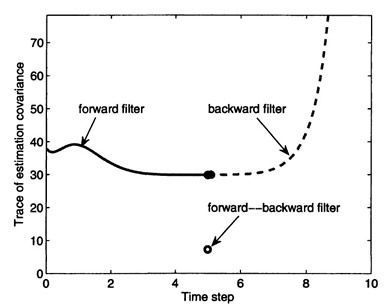 Figure 9.10 This shows the trace of the estimation-error covariance for Example 9.3. The forward filter runs from 9.4.2 RTS smoothing Several other forms of the fixed-interval smoother have been obtained. One of the most common is the smoother that was presented by Rauch, Tung, and Striebet, usually called the RTS smoother [Rau65]. The RTS smoother is more computationally efficient than the smoother presented in the previous section because we do not need to directly compute the backward estimate or covariance in order to get the smoothed estimate and covariance. In order to obtain the RTS smoother, we will first look at the smoothed covariance given in Equation (9.78) and obtain an equivalent expression that does not use Pbm. Then we will look at the snoothed estimate given in Equation (9.78), which uses the gain Kf, which depends on Pbm, and obtain an equivalent expression that does not use Pbm or 9.4.2.1 RTS covariance updateFirst consider the smoothed covariance given in Equation (9.78). This can be written as  where the second expression comes from an application of the matrix inversion lemma to the first expression (see Problem 9.3). Prom Equation (9.72) we see that  Substituting this into the expression ( 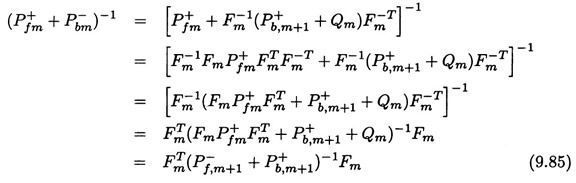 From Equations (6.26) and (9.76) recall that  We can combine these two equations to obtain  Substituting this into Equation (9.78) gives 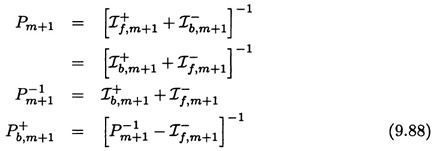 Substituting this into Equation (9.85) gives 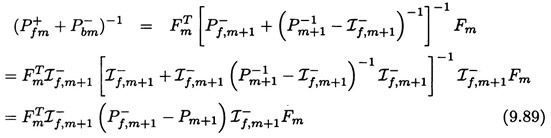 where the last equality comes from an application of the matrix inversion lemma. Substituting this expression into Equation (9.83) gives  where the smoother gain Kmis given as  The covariance update equation for Pm is not a function of the backward covariance. The smoother covariance Pmcan be solved by using only the forward covariance Pfm , which reduces the computational effort (compared to the algorithm presented in Section 9.4.1). 9.4.2.2 RTS state estimate updateNext we consider the smoothed estimate Lemma 1  Proof: From Equation (9.67) we see that  Rearranging this equation gives  Premultiplying both sides by Lemma 2The a posteriori covariance  Proof: From Equation (9.78) we obtain 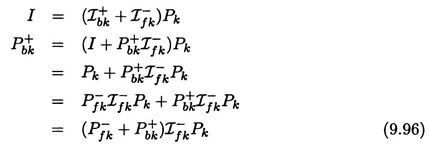 QED Lemma 3The covariances of the forward and backward filters satisfy the equation  Proof: From Equation (9.67) and (9.72) we see that  Adding these two equations and rearranging gives  QED Lemma 4The smoothed estimate  Proof: From Equations (9.69) and (9.82) we have  From Equation (9.76) we see that  Substitute this expression for  Now substitute  QED Lemma 5  Proof: Recall from Equations (6.26) and (9.72) that  Combining these two equations gives 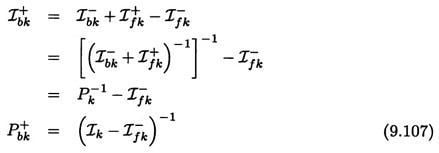 where we have used Equation (9.78) in the above derivation. Substitute this expression for  Invert both sides to obtain 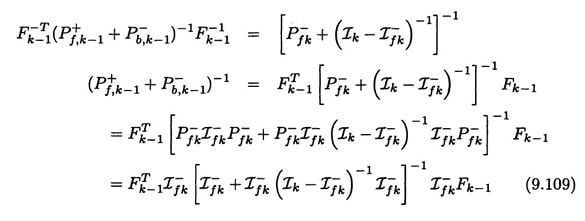 Now apply the matrix inversion lemma to the term 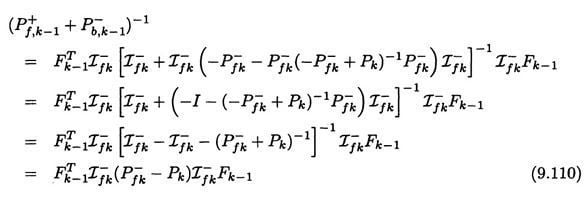 QED With the above lemmas we now have the tools that we need to obtain an alternate expression for the smoothed estimate. Starting with the expression for 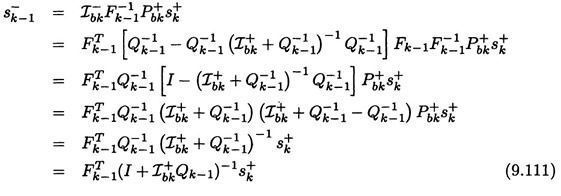 Rearranging this equation gives  Multiplying out this equation, and premultiplying both sides by  Substituting for  Substituting in this expression for
Substituting for  Premultiplying both sides by  Substituting Equation (9.105) for  Now from Equation (9.105) we see that  So we can add the two sides of this equation to the two sides of Equation (9.118) to get  Now use Equation (9.100) to substitute for Pk  Rearrange this equation to obtain  From Equation (9.106) we see that  From Equation (9.67) we see that  Now substitute for Pkfrom Equation (9.90) and use Equation (9.91) in the above equation to obtain
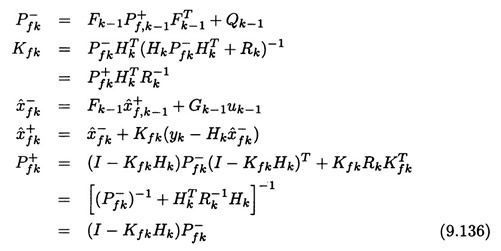
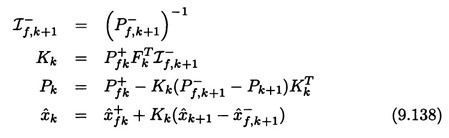
Premultiplying both sides by  Now use Equation (9.91) to notice that the coefficient of  Using Equation (9.90) to substitute for  Since this is the coefficient of  Now from Equations (9.78) and (9.82) we see that  From this we see that 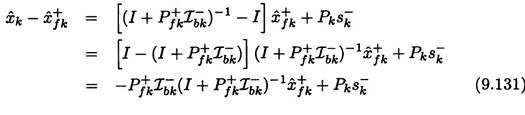 Rewriting the above equation with the time subscripts (k - 1) and then substituting for the left side of Equation (9.129) gives  from which we can write  This gives the smoothed estimate The RTS smoother
     |
 f, is based on the standard Kalman filter that operates from k = 1 to k = m. The second estimate,
  = 0. The estimates
  is the covariance of the forward estimate, and Pb =
  is the covariance of the backward estimate. Setting this equal to zero to find the optimal value of Kfgives
 must be infinite:

 after the measurement at time N is processed. Then it will be extrapolated backward in time to obtain
  , and so on.
 at the final time k = N. We can solve this problem by introducing the new variable
 means that we cannot run the standard Kalman filter backward in time because we have to begin with an infinite covariance. Instead we run the information filter from Section 6.2 backward in time. This can be done by writing the system of Equation (9.65) as
 should always exist if it comes from a real system, because Fk comes from a matrix exponential that is always invertible (see Sections 1.2 and 1.4). The backward information filter can be written as follows.
 = 0.
= 0. above requires the inversion of
  . Consider the first time step for the backward filter (i.e., at k = N). The information matrix
  . If there are fewer measurements than states,
  bk
bk +
+  . Substituting these expressions into the above equation for
  gives
gives

 and its covariance
  . These quantities are obtained from measurements m + 1, m + 2, …, N.
 and
and  +
+  and postmultiplying both sides by
  gives thedesired result.
  of the backward filter satisfies the equation
 , and the expression for
  from Equation (9.67),into Equation (9.101) to obtain
 for Kfk [from Equation (9.67)] in the above equationto obtain
 in the above equation. This results in
 in Equation (9.76), and substituting the expression for
 +
+ 
 . Also note that part of the coefficient of
  on the left side of the above equation can be expressed as
 . Therefore Equation (9.122) can be written as
 gives
gives allows us to write the above expression as