Aircraft Landing Gear Design: Principles and Practices

Brakes, in conjunction with a skid control system (if provided), are used to stop, or help stop, an aircraft. They are also used to steer the aircraft by differential action, to hold the aircraft stationary when parked and while it is running up its engines, and to control speed while taxiing. Most aircraft use disk brakes. The primary variables to consider are disk material and diameter and the number of disks.
Skid control systems are used to minimize stopping distance and to reduce the possibility of excessive tire wear and blowout caused by excessive skidding. The systems do this by constantly sensing the available degree of friction coefficient and by monitoring brake pressure to provide a fairly constant brake force almost up to the skidding point.
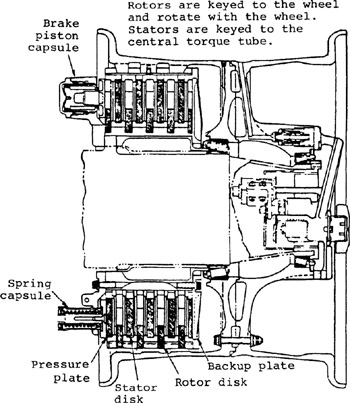
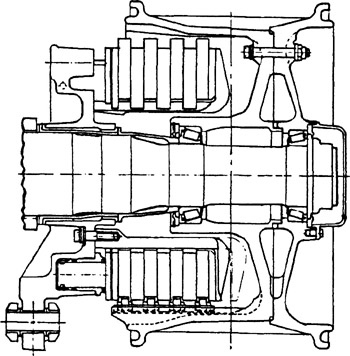
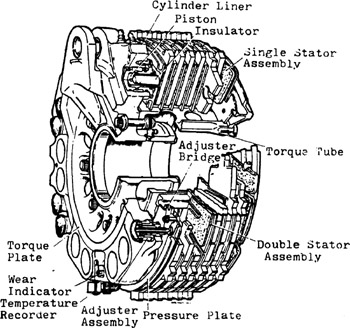
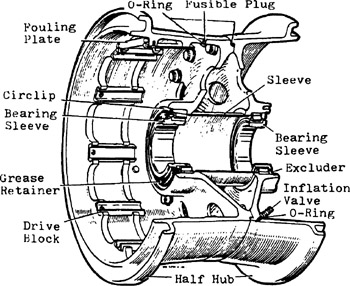
In order to illustrate the terminology and configuration of wheels and brakes, Figs. 7.1 and 7.2 are included to show sections through typical assemblies; Figs. 7.3 and 7.4 show further details of a matching wheel and brake.
Chapter 4 provides a comprehensive review of the requirements that are of interest to the landing gear designer. Applicable requirements for brakes are ARP 1493, BCAR Chapter D4-5, MIL-W-5013, TSO-C26b, U.S. Navy SD-24, and MIL-PRIME specification MIL-L-87139. For wheels, the requirements refer to ARP 1493 and 1907, AIR 1934, MIL-W-5013, and FAR Part 25. Guidance for skid control design is provided in AIR 804...