Analytical Mechanics of Space Systems

Chapter 1: Particle Kinematics

1.1 Introduction

Kinematics is a branch of dynamics that studies aspects of motion apart from considerations of masses and forces. Essentially, kinematics is a collection of vector/matrix methods to describe positions, velocities, and accelerations of particles and rigid bodies, as viewed from various reference frames. The subfield of particle kinematics considers only the motion of particles. This in itself can be quite challenging at times. As an example, consider a person driving a car on the highway. The road itself is fixed to a constantly rotating Earth, which in turn is orbiting the sun. What is the velocity and acceleration of the person relative to a sun-fixed coordinate system? This chapter will help answer these and many related questions.

1.2 Particle Position Description

1.2.1 Basic Geometry

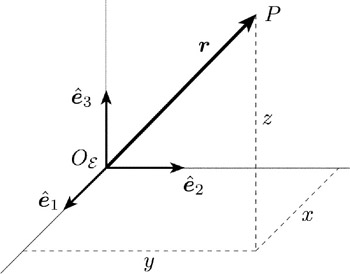
When studying the kinematics of particle motion, one is not concerned about the physical dimensions or mass of a particle. Let P be a point in a three-dimensional space as illustrated in Fig. 1.1. To define the position of the point P, a coordinate system along with its origin must be chosen. Without this coordinate system, it is difficult to describe the position of point P. To visualize this problem, imagine one person A telling another person B that his or her location is "10 miles." Without knowing from what reference point person A measured 10 miles and in what direction it was measured, it is impossible for person B to know the meaning of "10 miles."


Figure 1.1: The...

UNLIMITED FREE
ACCESS
TO THE WORLD'S BEST IDEAS

SUBMIT
Already a GlobalSpec user? Log in.

This is embarrasing...

An error occurred while processing the form. Please try again in a few minutes.

Customize Your GlobalSpec Experience

Category: Radiation Detectors
Finish!
Privacy Policy

This is embarrasing...

An error occurred while processing the form. Please try again in a few minutes.