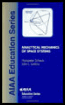
Analytical Mechanics of Space Systems

Chapter 2: Newtonian Mechanics

2.1 Introduction

The previous chapter on particle kinematics dealt with vector methods for describing a motion. Now we want to establish complete motion models that permit us to solve for the motion once the system forces and torques are given. Mass distribution and point of application of forces of a dynamical system clearly affect the resulting motion and must be taken into account. The motions are found by solving the system equations of motion that form the cause/effect model between the forces acting on the system and the resulting translational, rotational, and deformational accelerations.

In this chapter, we first consider the dynamics of a single particle and then that of a system of particles. An example of a system of particles would be the solar system with the various planets within it idealized as particles. The particle mechanics results will then be generalized to derive formulations for the dynamics of a continuous system. Examples of such systems include a vibrating beam or a generally deformable collection of matter (such as a bowl of gelatin) where the system shape may be time varying.

2.2 Newton's Laws

The following laws of nature were discovered by Sir Isaac Newton over 200 years ago in England. Later in the early 20th century, Albert Einstein theorized in his papers about special relativity that these basic laws were only a low-speed approximation. However, relativistic effects become significant only when the velocity of a particle or body approaches that of the speed of light.

UNLIMITED FREE
ACCESS
TO THE WORLD'S BEST IDEAS

SUBMIT
Already a GlobalSpec user? Log in.

This is embarrasing...

An error occurred while processing the form. Please try again in a few minutes.

Customize Your GlobalSpec Experience

Category: HEPA Filters and ULPA Filters
Finish!
Privacy Policy

This is embarrasing...

An error occurred while processing the form. Please try again in a few minutes.