Big Book of Internet File Transfer RFCs
A collection of Internet standards documents (RFCs) on FTP and related protocols.
 TABLE OF CONTENTS
 The gateway architecture, termed a protocol translator [NIST86], is depicted in Figure 3. It implements TCP/IP and OSI protocol stacks with an application level process providing the link between the two. The link between FTP and FTAM is defined by two sets of protocol mappings, one each for the FTP-Initiated and FTAM-Initiated service sets.
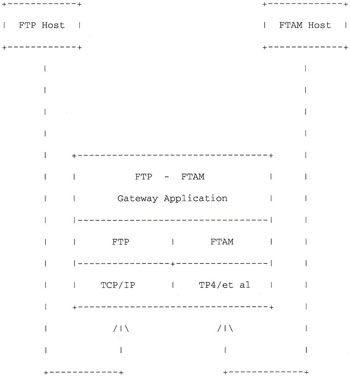
A fundamental aspect of this gateway architecture is that data is mapped and transmitted immediately; i.e., no transferred file need ever reside on the gateway file system. In the context of this document, the term "filesystem" refers to the file access and maintenance mechanisms provided by the operating system. This lack of gateway filesystem interaction helps speed up the end-to-end data transfer. Another speed-enhancing feature of this architecture is that both the FTP and FTAM network connections can operate simultaneously. Additional advantages include:
FTP and FTAM hosts require no modification to utilize gateway services.
Users require no knowledge of the other protocol.
Gateway access control is not impaired (since users cannot directly access the gateway filesystem).
No additional filesystem space is required on the gateway.
Interactive nature of protocols is preserved.
Users become aware of fatal errors immediately.
Disadvantages of this design include the initial coding effort required to develop the gateway and the subsequent re-coding efforts required to keep it current.