Call Center Operation: Design, Operation, and Maintenance
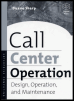
Gives complete coverage of the critical issues involved in the design, implementation, organization, and management of a customer call center.
 TABLE OF CONTENTS
 During the past decade in particular, the influence of technology on the relationships between organizations in both the public and private sectors has increased dramatically. Today, companies depend heavily on technology of various types to conduct their businesses and to deal with their customers, whether through a business-to-business (B2B) or a company-customer relationship. The call center industry especially is changing the face of business throughout the world and is having a significant impact on economies and the way companies do business.
Call centers require the integration of several different technologies to maximize the use of information and to streamline the activities of call center operators. Advances in technology and the adaptation and integration of synergistic technologies have resulted in the development of numerous feature that have enhanced the growth of call centers throughout the world.
The computer and the telephone are two of the major and most familiar tools of technology that have converged to make call centers more efficient and productive. When used properly along with software technology that assists operators to assimilate and analyze customer data to respond knowledgeably to customer inquiries, the benefits to both the customer and the organization are substantial, as this book will demonstrate.
Over the past few years, there has been much discussion of the pros and cons of a new set of technologies involving the integration of the computer and the telephone, referred to as CTI (for computer telephony integration, frequently shortened to computer telephony