Radio signals can be used to carry information. The information, which may be audio, data or other forms, is used to modify (modulate) a single frequency known as the carrier. The information superimposed onto the carrier forms a radio signal which is transmitted to the receiver. Here, the information is removed from the radio signal and reconstituted in its original format in a process known as demodulation. It is worth noting at this stage that the carrier itself does not convey any information.
There are many different varieties of modulation but they all fall into three basic categories, namely amplitude modulation, frequency modulation and phase modulation, although frequency and phase modulation are essentially the same. Each type has its own advantages and disadvantages. A review of all three basic types will be undertaken, although a much greater focus will be placed on those types used within phone systems. By reviewing all the techniques, a greater understanding of the advantages and disadvantages can be gained.
Radio Carrier
The basis of any radio signal or transmission is the carrier. This consists of an alternating waveform like that shown in Figure 3.1. This is generated in the transmitter, and if it is radiated in this form it carries no information it appears at the receiver as a constant signal.
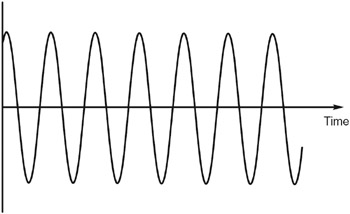 Figure 3.1: An alternating waveform.
 Amplitude Modulation
Possibly the most obvious method of modulating a carrier is to change its amplitude in line with the modulating signal.
The simplest form of amplitude modulation...
Copyright Ian Poole 2006 under license agreement with Books24x7

 TABLE OF CONTENTS