Cellular Communications Explained From Basics to 3G
System Architecture

The architecture of the GSM system has been proven to be very successful, many of the names and ideas being adopted by other systems. Its basic concepts are also incorporated in the new UMTS/W-CDMA 3G system as well, although many of the names are slightly different to prevent confusion.

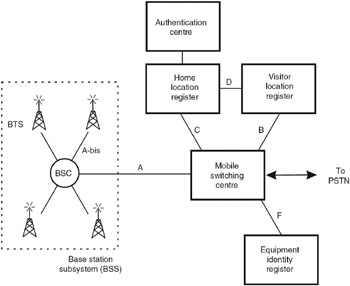
The main elements of the system are the Base Transceiver Station (BTS), the Base Station Controller (BSC), the Mobile Switching Centre (MSC) and the registration and authentication areas (Figure 6.1). These include the Home Location Register (HLR), the Visitor Location Register (VLR), the Equipment Identity Register (EIR) and the Authentication Centre (AuC).


Figure 6.1: The GSM network configuration.

The BTS is the primary communication area with the mobiles. The BTS transmits and receives the signals from them handling the interface protocols. The BTS is then linked to a BSC, which controls a small group of BTSs. These two are linked using an interface known as the A-bis interface. Like all the other interfaces between elements of the GSM network, this is now rigorously defined to enable equipment from different manufacturers to be used together. However, some of this standardization came late, and it means that many older components are proprietary makes, enabling only BSCs and BTSs from particular manufacturers to be connected.

The BSC manages one or more BTSs. It handles the radio channel set-up, frequency hopping control and handovers. It links with the MSC or mobile switching centre via an interface termed the...

UNLIMITED FREE
ACCESS
TO THE WORLD'S BEST IDEAS

SUBMIT
Already a GlobalSpec user? Log in.

This is embarrasing...

An error occurred while processing the form. Please try again in a few minutes.

Customize Your GlobalSpec Experience

Category: Telephones and Cellular Phones
Finish!
Privacy Policy

This is embarrasing...

An error occurred while processing the form. Please try again in a few minutes.