Data Networks: Routing, Security, and Performance Optimization

Provides coverage of routing, security, multicasting, and advanced design topics, as well as strategies for overcoming challenges in network design and management.
 TABLE OF CONTENTS
 TCP/IP implements a universal addressing scheme. Every device on an IP network, and every IP network itself, has a unique address that identifies it. This addressing scheme enables communication for millions of devices over public networks such as the Internet, as well as private intranets.
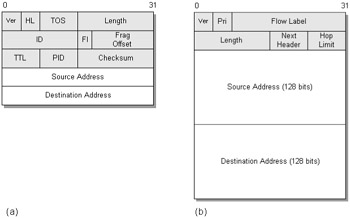
We start by reviewing the provisions made within the IP protocol itself for Network Layer addressing. This is complicated by the fact that two versions of the IP protocol (IP version 4 and IP version 6) are likely to coexist on public and private networks for some time, for reasons we will discuss later in this chapter. Figure 2.2 illustrates the relative size of the address fields for IPv4 and IPv6. IPv4 provides 32 bits each for both the source and destination address fields. While this may seem huge, with 4,294,960,000 possible addresses available to each field (i.e., 2 32), we will discuss why the hierarchical model chosen for IPv4 has led to serious problems with address depletion. IPv6 provides 128 bits per address and implements a new addressing model designed to overcome some of the more obvious problems with IPv4. This addressing scheme makes it possible for devices such as IP routers to deliver messages between hosts in different parts of the world. With IPv4 each host has a unique address composed of a 32-bit (4-byte) number, and this is broken down into two parts: