Data Networks: Routing, Security, and Performance Optimization
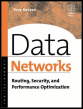
Provides coverage of routing, security, multicasting, and advanced design topics, as well as strategies for overcoming challenges in network design and management.
 TABLE OF CONTENTS
 Organizations are increasingly reliant on computer networks for business-or mission-critical applications. The scope and size of these networks have expanded so rapidly over the past two decades that considerable effort and expense are now targeted at keeping network resources available, sometimes 24 hours a day, all year. Traditionally this area of network design has been the preserve of large mainframe sites and those sites requiring high levels of protection (such as nuclear power plants). However, the explosion of Web-based business methods means than many more organizations are now eager to maintain high availability in order to minimize service losses (Table 6.1 illustrates the kinds of losses we could expect by industry type and operation). If the network is poorly designed, and insufficient attention is paid to providing availability in core systems, users can experience anything from slow response times to complete loss of service (referred to as downtime) for extended periods. The technical issues in maintaining high availability are both complex and subtle, and it is the network designer's job to balance loss probability against cost, providing guidance to senior management on the likelihood of failures and their impact on the business.
| Industry | Operation | Avg Cost per hour Downtime ($K) |
|---|---|---|
| Financial | Brokerage | $6,450.0 |
| Financial | Credit Card/Sales Authorisation | $2,600.0 |
| Media | Pay-Per-View | $150.0 |
| Financial | ATM Fees | $145.0 |
| Retail | Home Shopping (TV) | $113.0 |
| Retail | Home Catalog Sales | $90.0 |
| Transportation | Airline Reservations | $89.5 |
| Media | Tee-Ticket Sales | $69.0 |