Developing Time-Oriented Database Applications in SQL
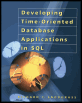
An enjoyable plunge into the how-to of time and data, with real-world situations and code.
 TABLE OF CONTENTS
 A period is a segment of the time line, starting at one instant and terminating at a later instant.
While there are a variety of representations of periods, one particular representation is preferable.
Periods are more complex than instants, because there is no total order on periods, unlike instants.
SQL-92 has essentially one construct, OVERLAPS, that is relevant to periods. However, the draft SQL3 standard includes a period type constructor, period literals, predicates, and value constructors.
An instant has no duration. Yet facts in the database are true over a duration of time. To express when a fact holds in the enterprise, a period is associated with that fact.
| Tip | A period is an anchored duration of the time line. |
A period is an anchored duration of the time line. The Fall 1997 academic semester at the University of Arizona comprises the period from August 25, 1997 to December 19, 1997. This data type, while quite useful, is not supported directly by any commercial DBMS, nor is it in the SQL-92 standard. However, periods are in the SQL3 draft standard, as will be discussed in Section 12.4.
Perhaps the reason that periods were not included with the other temporal types in SQL-92 is that they are relatively easy to simulate with datetimes. The most common representation is with a pair of instants, the first specifying the first day (second, microsecond) of the period and the second specifying the last day (second, microsecond) of the period. Generally the...