Developing Time-Oriented Database Applications in SQL
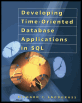
An enjoyable plunge into the how-to of time and data, with real-world situations and code.
 TABLE OF CONTENTS
 and an ocean tumbled by with a private boat for Max
and he sailed off through night and day
and in and out of weeks
and almost over a year
to where the wild things are.
Maurice Sendak, Where the Wild Things Are
And which of you by being anxious can add one cubit to his span of life?
Matthew 6:27
An interval is an unanchored contiguous portion of the time line. An interval is relative; an instant is absolute. An interval can be added to an instant, yielding another instant. Intervals cannot be added to spatial points, nor spatial intervals (such as cubits) to temporal intervals, except as (often highly effective) literary devices, as the above quotes illustrate.
| Tip | An interval is an unanchored, directional duration of the time line. |
The distance between two instants is an interval. Unlike instants, intervals have direction. An interval can be positive or negative, denoting a shift to the future or to the past.
Intervals are less prominent in the FINDER schema than instants. Some are signaled with "duration" or "interval" in their name, examples being the Period_Durtn column in Well_Test_Period and the Sampling_Interval column of the Seis_Survey_Hdr table, or by mentioning the time during which something was happening, as in the Time_String_In_Hole column of the Well_Log_Service table. Other interval columns are more obscure, such as the Incrmnt_Time column of the Stage_Flowback table (other columns having...