Digital Interface Handbook, Third Edition

4.3: Standard Two-Channel Interface Principles

4.3 Standard Two-Channel Interface Principles

Common to all the international standards for a two-channel interface is the data format of the subframe containing samples of audio data for each channel. There are two principal electrical approaches used for the standard two-channel interface: one is unbalanced and uses relatively low voltages, the other is balanced and uses higher voltages. AES3-ID-2001 also describes an unbalanced coaxial link for use over distances beyond 100 m (see section 4.3.6).

4.3.1 Data Format

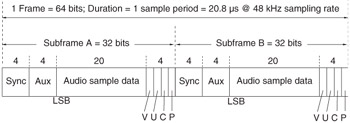
The interface is serial and self-clocking. That is to say that two channels of audio data are carried in a multiplexed fashion over the same communications channel, and the data is combined with a clock signal in such a way that the clock may be extracted at the receiver and used to synchronize reception. As shown in Figure 4.1, one frame of data is divided into two subframes, handling channels 1 and 2 respectively. Channels 1 and 2 may be independent mono signals or they may be the left and right channels of a stereo pair, and they are separately identified by the preamble that takes up the first four clock periods of each subframe. Samples of channels 1 and 2 are transmitted alternately and in real time, such that two subframes are transmitted within the time period of one audio sample thus the data rate of the interface depends on the prevailing audio sampling rate.


Figure 4.1: Format of the standard two-channel interface frame.

The subframe format consists of...

UNLIMITED FREE
ACCESS
TO THE WORLD'S BEST IDEAS

SUBMIT
Already a GlobalSpec user? Log in.

This is embarrasing...

An error occurred while processing the form. Please try again in a few minutes.

Customize Your GlobalSpec Experience

Category: Channel Service Units (CSU) and Data Service Units (DSU)
Finish!
Privacy Policy

This is embarrasing...

An error occurred while processing the form. Please try again in a few minutes.