Op Amp Applications Handbook

Walt Kester
This chapter of the book deals with data conversion and associated signal conditioning circuitry involving the use of op amps. Data conversion is a very broad topic, and this chapter will provide only enough background material for the reader to make intelligent decisions regarding op amp selection. Much more material on the subject is available in the references (see References [1] [2] [3] [4] [5]).
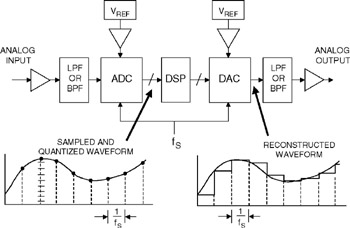
Figure 3-1 shows a generalized sampled data system and some possible applications of op amps. The analog input signal is first buffered and filtered before it is applied to the analog-to-digital converter (ADC). The buffer may or may not be required, depending upon the input structure of the ADC. For example, some ADCs (such as switched capacitor) generate transient currents at their inputs due to the internal conversion architecture, and these currents must be isolated from the signal source. A suitable buffer amplifier provides a low impedance drive and absorbs these currents. In some cases, an op amp is required to provide the appropriate gain and offset to match the signal to the input range of the ADC.
Another key component in a sampled data system is the antialiasing filter which removes signals that fall outside the Nyquist bandwidth, fs/2. Normally this filter is a low-pass filter, but it can be a band-pass filter in certain undersampling applications. If the op amp buffer...