Open Channel Hydraulics

Flow in an open channel is called uniform flow or normal flow if the depth, flow area, and velocity remain constant at every cross-section along the channel. Strictly speaking, normal flow is possible only in prismatic channels, and it rarely occurs naturally. However, the flow tends to become normal in very long channels in the absence of flow controls such as hydraulic structures. The normal flow equations to be presented in this chapter appear to be satisfied even in irregular channels in the absence of hydraulic structures. Moreover, the concept of normal flow is central to the analysis and design procedures for open channels.
Resistance to flow can be explained in terms of the external or internal friction forces. External friction forces are encountered on the channel boundary, and are included in the momentum equation as we discussed in Chapter 1. The internal friction forces, however, occur due to velocity gradients within a flow cross-section. The energy equation derived in Chapter 1 includes the energy losses due to the internal friction. It is more convenient, and traditional, to explain the flow resistance in terms of the boundary friction.
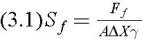
In Section 1.6.2, we defined the friction slope, S f, as the boundary friction force per unit weight of water present in the channel. For a channel segment of length ? X, flow area A, and wetted perimeter P,
where ? = specific weight of water and F f =...