Open Channel Hydraulics

4.5: GRADUALLY-VARIED FLOW COMPUTATIONS

4.5 GRADUALLY-VARIED FLOW COMPUTATIONS

We can solve either Equation 4.5 or Equation 4.7 in order to determine the gradually-varied flow depths at different sections along a channel. However, we find Equation 4.5 more convenient for this purpose. As we pointed out before, this is a differential equation; a boundary condition is required for solution. It is very important to remember that subcritical flow is subject to downstream control. Therefore, if flow in the channel is subcritical, then a downstream boundary condition must be used to solve Equation 4.5 given Q. Conversely, supercritical flow is subject to upstream control, and an upstream boundary condition is needed to solve Equation 4.5 for supercritical flow. By boundary condition, we generally mean a known flow depth associated with a known discharge.

Analytical solutions to Equation 4.5 are not available for most open-channel flow situations typically encountered. In practice, we apply a finite difference approach to calculate the gradually-varied flow profiles. In this approach, the channel is divided into short reaches and computations are carried out from one end of the reach to the other.

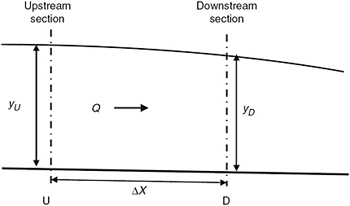
Consider the channel reach shown in Figure 4.11 having a length of ? X. Sections U and D denote the flow sections at the upstream and downstream ends of the reach, respectively. Using the subscripts U and D to denote the upstream and downstream sections, we can write Equation 4.5 for this reach in finite difference form as


Figure 4.11: Definition sketch for gradually-varied flow formulation

where S

UNLIMITED FREE
ACCESS
TO THE WORLD'S BEST IDEAS

SUBMIT
Already a GlobalSpec user? Log in.

This is embarrasing...

An error occurred while processing the form. Please try again in a few minutes.

Customize Your GlobalSpec Experience

Category: Industrial Valves
Finish!
Privacy Policy

This is embarrasing...

An error occurred while processing the form. Please try again in a few minutes.