Open Channel Hydraulics

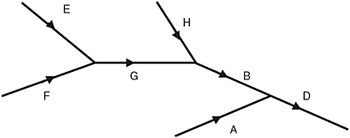
The gradually-varied flow calculations can also be used for channel systems. A schematic of a channel system is shown in Figure 4.26. If the flow in the system is subcritical, we first calculate the profile in channel D (most downstream channel) and proceed in the upstream direction. The calculations are performed for each channel individually. If the flow in the system is supercritical, we first calculate the profiles in channels E and F (most upstream channels) and proceed in the downstream direction. However, at channel junctions, where two or more channels meet, a junction equation should be satisfied to account for the interaction between the channels. The continuity equation should always be satisfied. For instance, for steady flow, Q D = Q A + Q B in Figure 4.26. Likewise, Q B = Q G + Q H.
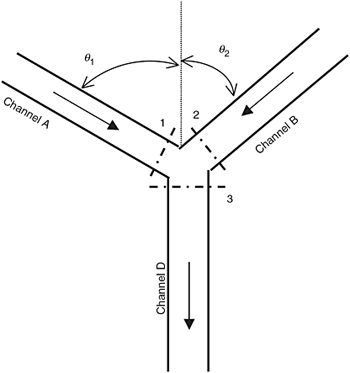
Also, either the energy or the momentum equation should be used at the junction. For subcritical flow, it is convenient to use the energy equation. Figure 4.27 displays a schematic of a junction where three channels meet. Let Section 3 represent the most upstream section of channel D, and Sections 1 and 2, respectively, represent the most downstream sections of channels A and B. Let the junction area between these three sections be negligible. Then the energy equation between Sections 1 and 3 can be written as