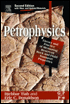
Petrophysics: Theory and Practice of Measuring Reservoir Rock and Fluid Transport Properties
This chapter describes the characteristics of the flow of fluids through porous geological materials. The pores, or flow conduits, are complex, inter-connected capillaries and channels of variable sizes as described in previous chapters. The flow of compressible and incompressible fluids through porous rocks is described by Darcy's Law and its derivatives. The simplest case of fluid flow through porous media is the linear flow of a single-phase fluid under a constant pressure gradient, which is known as linear steady-state flow. When two fluids are present in a porous medium, steady-state flow occurs under a constant pressure gradient only when the fluid staturations remain constant. If the saturations change with respect to time (for example, if the water saturation is increasing while the oil saturation is decreasing), the flow of fluids is characterized as unsteady-state flow.
Steady-state and pseudosteady-state flow rate equations, based on Darcy's law for linear and radial flow of compressible and incompressible fluids, can be used to predict the production performance of porous and permeable flow systems of simple geometry. In steady-state flow systems, the pressure and fluid velocity at every point throughout the porous system adjust instantaneously to changes in pressure or flow rate in any part of the system [1]. This flow condition occurs only when the rock is 100% saturated with a fluid and the pressure of the porous media is effectively maintained constant by either an active aquifer or the injection of a displacing fluid, i.e., fluid withdrawal from the porous rock is...