Properties of Silicon Germanium and SiGe: Carbon

5.3: Injection Across a Si/SiGe Heterojunction

5.3 Injection Across a Si/SiGe Heterojunction

H. Jorke
September 1999

A INTRODUCTION

Injection currents across heterojunctions are influenced by multiple factors such as material properties (bandgap, dielectric constant, effective carrier masses), interface properties (conduction and valence band discontinuities) and electrostatic forces that are related to the specific doping situation and the presence of an external bias.

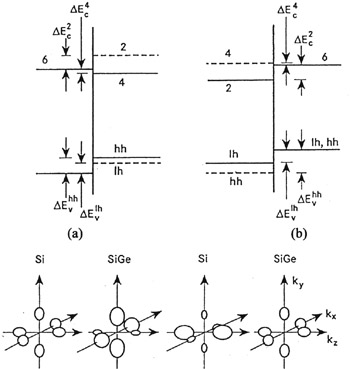
In Si/Si 1-xGe x heterojunctions material properties are largely determined by the value of the Ge fraction x (0 < x < 1). In contrast, interface properties (conduction and valence band discontinuities) do not solely depend on x but are also strongly or even dominantly influenced by factors such as crystal orientation (the present data are related to (100) oriented interfaces) and the presence of layer strain. The latter is an inherent property of the lattice mismatched Si/Si 1-xGe x heterosystem [1]. To illustrate the specific strain influence on band discontinuities FIGURE 1 shows the energy band diagram for Si and Si 1-xGe x isolated (i.e. without space charges) if (a) Si is unstrained (Si 1-xGe x is under compressive strain) and (b) Si 1-xGe x is unstrained (Si is under tensile strain).


Figure 1: Band alignments in pseudomorphic Si/Si 1-xGe x heterojunctions for (a) Si 1-xGe x strained and (b) Si strained. Depending on whether strain is compressive (Si 1-xGe x) or tensile (Si) the transverse (four-fold degenerate) or vertical (two-fold degenerate) conduction band valleys are dominantly...

UNLIMITED FREE
ACCESS
TO THE WORLD'S BEST IDEAS

SUBMIT
Already a GlobalSpec user? Log in.

This is embarrasing...

An error occurred while processing the form. Please try again in a few minutes.

Customize Your GlobalSpec Experience

Category: Semiconducting Materials
Finish!
Privacy Policy

This is embarrasing...

An error occurred while processing the form. Please try again in a few minutes.