Seals and Sealing Handbook, Fifth Edition

An introduction to the subject of sealing technology, this book provides an understanding of the issues involved and sufficient information to assist with achieving reliable and effective sealing.
 TABLE OF CONTENTS
 For sealing rotary shafts in a pressurized system a lip seal has limitations, as discussed in section 3.2.9 above. Some of these limitations will apply to any seal design, most specifically the problem of achieving a compromise between frictional heat and sealing function. A number of seal designs have been developed for rotary applications. These seals generally offer the benefit of a compact seal envelope compared with alternatives such as mechanical seals or packing. The individual selection will depend on the seal life, leakage, permissible seal housing geometry and reliability requirements of each application.
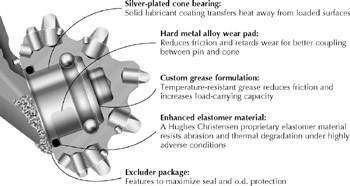
It is possible to use O-rings as a rotary seal and they are widely used as bearing seals for down hole drilling rock bits, Figure 3.47. However, in this application a compact seal with limited life expectancy is required. A specific property of elastomers can cause additional problems in highly loaded seals, this is what is known as the Gough Joule effect. They showed that if elastomer under tension is heated it will tend to increase in modulus. In commercial elastomers this tends to be counteracted by the decrease in modulus with increasing temperature, but it can cause a transient increase in contact stress and hence friction. It is therefore usual to install O-rings for rotary applications with a small amount of circumferential compression to offset this effect.