Security Sage's Guide to Hardening the Network Infrastructure

This text provides detailed, hands-on coverage on how use network devices, protocols and design techniques to optimize the security of your Enterprise Network.
 TABLE OF CONTENTS
 Switching is designed to work within the confines of the Open Systems Interconnect (OSI) model. Unless you ve been operating your network from beneath a bridge (this will seem funnier later in the chapter), or under a rock, you should already be familiar with this concept. However, although the mechanics of the OSI model might not be foreign, the origins of the OSI model might.
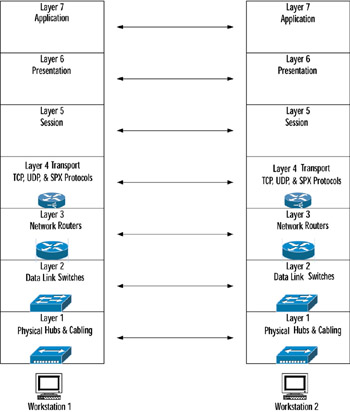
The International Standards Organization (ISO) created the seven-layer OSI model to explain how data travels across a network so that engineers could create their products with a common framework. The model divides all network information into seven discrete layers. Every node on the network has a component responsible for a specific layer of this model. Each node allows the appropriate component to code/decode the data, generically called a protocol data unit (PDU), intended for that layer. This allows the component responsible for a specific layer of the source computer to communicate directly with the component responsible for that same layer on the destination computer. This compartmentalizes the design process so that multiple engineers can successfully work on different pieces of the same product and allow for complete interoperability of that product with other products engineered to the same standard. Figure 7.1 presents a simplified view of the model.
The OSI model mainly serves as a guide for the advisory bodies that really create the standards. Much of the networking...