Selected Topics in Advanced Solid State and Fibre Optic Sensors

The recent introduction of monomode fibres with special polarisation characteristics offers the possibility of producing a variety of sensors. Polarisation-maintaining, single-polarisation and ultra-low birefringent fibres are currently available on the market. The polarisation-maintaining fibre is a highly birefringent fibre, where the birefringence is the result of anisotropic thermal stress between the core and the stress-producing sectors in the fibre (bow-tie or panda types). The high birefringence exhibited by these fibres maintains the learly polarised light, masking the effect of external bends or twists. In a similar manner, in single-polarisation fibres, one polarisation state suffers a high attenuation (50 dB/km) while the other suffers a low attenuation (5 dB/km). Single-polarisation fibres can be used as intrinsic sensors as the birefringence changes with both longitudinal strain and temperature. The state of polarisation can also be affected by the presence of electric or magnetic fields, and a variety of sensors can be realised using the Faraday magneto-optic effect, the electrogyration effect, the Kerr effect, the Pockels effect, the photo-elastic effect, or the optical activity of solutions.
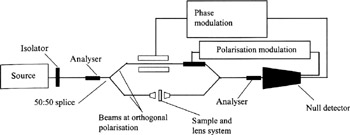
During the last few years, evolution has been towards encapsulating the light paths in optical interferometers (Michelson, Mach-Zehnder, Sagnac), so as to act as compact stable elements that use phase rather than amplitude as the sensing parameter. An example of a null-balance Mach-Zehnder polarising interferometer implemented using monomode polarisation-maintaining fibres that may be implemented to measure the complex transmission coefficient of a sample is shown in Figure 3.26.