Selected Topics in Advanced Solid State and Fibre Optic Sensors

A large number of organic, inorganic or organometallic compounds can be polymerised. Their physical, chemical and electrical properties depend on complex sets of interacting factors, that include molecular structure, molecular size and cross-link density. Of the many types of polymeric materials, electrically conducting organic polymers have attracted much interest because their unusual properties lend themselves to many novel applications. Previously, organic polymers were considered good insulators. However, this concept was radically changed when it was shown that the conductivity of polyacetylene can be increased via doping by 13 orders of magnitude, up to about 10 4 S cm ?1. The class of polymers known as electrically conducting polymers was born [1].
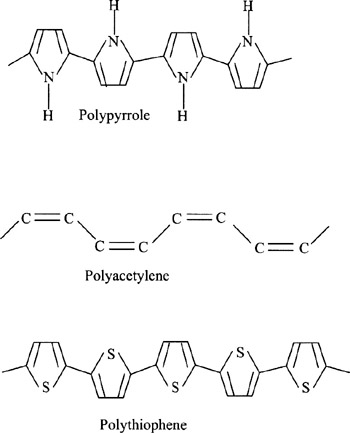
Conducting polymers are conjugated organic materials, and these differ from redox polymers in that the polymer backbone is itself conducting (see Figure 6.1). The conductivity of the materials can be modulated from the non-conducting form to highly conducting form by the addition of dopant ions into the polymer matrix. This can be accomplished electrochemically or via purely chemical pathways.
Although there is a large body of research on polyacetylenes, the instability of many of these materials in air, until recently, limited the number of practical applications. Of the many conducting polymers investigated, it can be said that polypyrrole is currently the most popular. Chemical methods for the oxidative polymerisation of pyrrole had been known for many years, but when Diaz