SIMOX

3.1: INTRODUCTION

3.1 INTRODUCTION

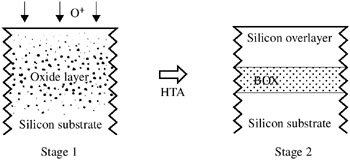
Ion implantation is the term used to denote the injection of impurity atoms in the form of fast ions into a target for the purpose of modifying the properties of the target. When this results in the formation of a chemical compound or alloy in the target the process is referred to as ion beam synthesis (IBS). The synthesis of SIMOX material is a two-step process, which results in the formation of a silicon on insulator (SOI) structure, as shown schematically in FIGURE 3.1. Stage 1 involves the implantation of a large dose of reactive O + ions into single crystal silicon to synthesise silicon dioxide. Stage 2 involves a high temperature anneal (HTA) both to annihilate lattice defects and redistribute the implanted oxygen to form a buried layer of homogeneous, stoichiometric SiO 2 with abrupt oxide-silicon interfaces. In this chapter, for clarity, only the buried stoichiometric SiO 2 layer, which evolves during the HTA, is referred to as the buried oxide or BOX.


Figure 3.1: Schematic showing the basic SIMOX process. Stage 1: O + implantation. Stage 2: high temperature anneal (HTA). The anneal converts the broad oxide layer into a homogeneous amorphous buried oxide (BOX).

By design an ideal SOI substrate is a strain and defect free, single crystal Si/amorphous SiO 2/single crystal Si (c-Si/a-SiO 2/ c-Si) structure with planar, abrupt interfaces and a high quality, homogeneous BOX. With only a cursory consideration one would conclude that such structures cannot...

UNLIMITED FREE
ACCESS
TO THE WORLD'S BEST IDEAS

SUBMIT
Already a GlobalSpec user? Log in.

This is embarrasing...

An error occurred while processing the form. Please try again in a few minutes.

Customize Your GlobalSpec Experience

Category: Wafer and Thin Film Instrumentation
Finish!
Privacy Policy

This is embarrasing...

An error occurred while processing the form. Please try again in a few minutes.