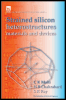
Strained Silicon Heterostructures: Materials and Devices
In Si homoepitaxy, emphasis is placed on obtaining a high growth rate to solve the problems of throughput and on reducing autodoping from deposition onto highly doped layers. In low temperature Si and Si 1 ? xGe x epitaxy, autodoping is not a problem and desired layer thicknesses are on the order of 100 nm or less. Precise control of the Ge and dopant concentration profiles becomes more important than high growth rates. Certain device applications can benefit from bandgap grading, so control of Ge incorporation down to 1 2% is desirable. In situ doping is a necessity to get the profiles without implantation. Control of in situ doping profiles down to 50 nm and formation of dopant peaks below the surface are extremely desirable for precise vertical dopant profiles and lower junction capacitance. Ion implantation cannot achieve these types of profiles. High and moderate labels of dopants of both types are needed to form device structures. Quick transitions from high to low and low to high dopant concentrations are also desired for the formation of lightly doped spacers.
The ability to in situ dope eliminates many of the implantation and anneal steps in a device fabrication process. The goal is to obtain good control of the dopant incorporation in the alloy layers. The ability to control p-and n-type dopants is necessary in the design of the vertical profile of transistors. In addition, the transition from high to low and low...