Strained Silicon Heterostructures: Materials and Devices
2.5: Binary Si1?xGex Alloy Films

2.5 Binary Si 1 ? xGe x Alloy Films

Most of the early work on binary Si 1 ? xGe x alloy films was performed using MBE whereas growth using CVD systems started much later. Several excellent reviews on SiGe alloy layers have appeared in the literature [1, 82, 83]. In the following, we briefly discuss the development and general characteristics of SiGe films grown using various techniques.

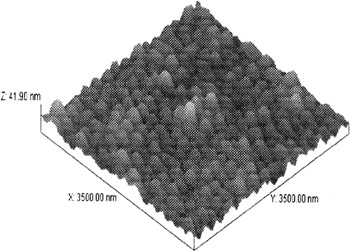
Kasper and Herzog [84] were the first to attempt the growth ofSi 1 ? xGe x on Si at 750 C using MBE. At this high temperature, three-dimensional growth and islanding were observed. Using MBE, the concept of strained layer epitaxy [85] was applied again to Si/SiGe material system by Bean et al. [86] in 1984 at a low temperature (550 C). In the case of strained layer epitaxy, lattice mismatched layers can be grown without misfit dislocations if the thickness is kept below a critical thickness. At this low temperature, it was found that the critical thickness for the epilayer was several times higher than the value that can be obtained from the mechanical equilibrium theory [87]. The key feature of this low temperature technique is that two-dimensional growth of strained Si 1 ? xGe x containing a high concentration of Ge is possible as shown in the atomic force micrograph (figure 2.7).


Figure 2.7: AFM surface image of a strained Si 0.74Ge 0.26 film grown on Si using gas-source...

UNLIMITED FREE
ACCESS
TO THE WORLD'S BEST IDEAS

SUBMIT
Already a GlobalSpec user? Log in.

This is embarrasing...

An error occurred while processing the form. Please try again in a few minutes.

Customize Your GlobalSpec Experience

Category: Thin Film Monitors
Finish!
Privacy Policy

This is embarrasing...

An error occurred while processing the form. Please try again in a few minutes.