The Technology of Audio and Video Streaming
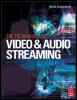
In this guide, the author demonstrates how to deploy the technology on your site, from video to audio capture through to the consumer's media player.
Why is a network drawn as a cloud? In all but the smallest of enterprises, the IT department maintains the computer network infrastructure. How many of us are concerned what happens beyond the RJ-45 jack on the wall? It says a lot for computer networks that we often forget the network is there. We haul files across the world at the click of a mouse, and they arrive seconds later.
With video media, things are different, we place much more demands on the network. So it helps to understand a little more about the IP network, and the telecommunications infrastructure that underpins it.
The first thing that is different about the delivery of multimedia streams is that usually they do not use the universal TCP. Second, the media files are very large compared with the average web page. Third, delivery in real-time is a prerequisite for smooth playback of video and audio.
A new set of network protocols has been developed to support multimedia streaming. Advances in Internet protocols (IPs) now support multicasting where one stream serves hundreds or thousands of players. This is a handy facility for optimizing network resources if you want to webcast live to large audiences.
The media files are streamed over the general telecommunications network. Again this is something we rarely think about, unless we want a new telephone switch. Communications channels become an issue as soon as you start to encode. The codec configuration menu will offer a number of compression choices: dial-up...

 TABLE OF CONTENTS