The Technology of Audio and Video Streaming
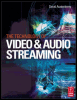
In this guide, the author demonstrates how to deploy the technology on your site, from video to audio capture through to the consumer's media player.
The usual way to make a streaming video is to start with a conventional television signal, live from a camera or pre-recorded from videotape. This video signal is converted to computer file format before it can be processed by the streaming codec. This is called capture.
There are many similarities between television and computer video, but there are minor differences in the standards and formats that are relevant to capture. This chapter gives an overview of the broadcast television standards for the reader who may be more familiar with computer formats like AVI and QuickTime. This chapter also covers the many tape formats you will encounter, and the different interconnections that can be used between the tape deck and the encoding workstation.
Although we live in a digital world, there is still much legacy analog equipment in use in video production. We must not forget that the majority of television viewers still watch an analog transmission, and the changeover to digital reception may not happen until 2010, varying from country to country. The pioneers in digital transmission have been the satellite operators, where the driving force for the deployment of digital transmission (using the MPEG-2 standard) has been the emission of four to six times the number of channels within a given transponder bandwidth. So any overview has to start in the analog domain.
Essentially, television is the reproduction of a moving two-dimensional image by the transmission of a regular sequence of color bit maps. Television started as a...

 TABLE OF CONTENTS