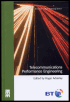
Telecommunications Performance Engineering
Telecommunications traffic is a phrase used to describe all the variety and complexity of the usage of a network. It is the comings and goings of demand, in response to user behaviour and to the network's reaction. Its detailed specification is a means to an end merely the first step in the evaluation of the quantities that are meaningful and useful to the network engineer, and therefore the type and complexity of its characterisation reflects the richness of its array of uses.
Time-honoured representations of network traffic by pure-chance streams, which have worked well for many years, are now insufficient. The new data networks display a complexity of behaviour which requires a corresponding richness of input, and this has required the development of a multitude of traffic descriptions. These include not only extensions of classical models, such as multi-bit-rate sources, but also such very different areas as the effective bandwidth models now in widespread use for ATM modelling, self-similar or fractal traffics, and the complex self-coupled and adaptive behaviour of TCP/IP traffic streams.
At the same time, the output required from modelling has increased significantly. No longer is a simple figure adequate, predicting overall mean delay or probability of call blocking: instead, entire flows or streams of demands now have to be treated as a whole, and new types of analysis and statistics are required which relate to the behaviour across packets but within a stream, such as delay variation.
The uses of real...