Total Operations Solutions
A holistic approach to Operations Management, this book focuses on value chain management, addresses new and current issues, and covers an implementation program to demonstrate how to put the methodology into practice.
 TABLE OF CONTENTS
 Skinner (1969) described manufacturing facilities as either a corporate millstone or a competitive weapon depending on the strategy applied and pursued. Wheelwright and Hayes (1985) defined the four stages of manufacturing's strategic role, as illustrated in Table 7.1.
| Stage | Strategy | Role |
|---|---|---|
| Stage 1 | Minimize manufacturing's negative potential: internally neutral | Manufacturing is kept flexible and reactive |
| Stage 2 | Achieve parity with competitors: externally neutral | Capital investment is the primary means for catching up with competition |
| Stage 3 | Provide credible support to the business strategy: internally supportive | Longer-term manufacturing developments and trends addressed systematically |
| Stage 4 | Pursue a manufacturing-based competitive advantage: externally supportive | Long-range programmes pursued in order to acquire capabilities in advance of needs |
| Source: Wheelwright and Hayes, 1985 |
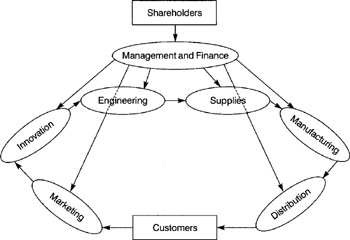
In a manufacturing business, a number of interrelated functions (such as marketing, innovation, engineering, purchasing, manufacturing and distribution) work towards a common objective of satisfying the customers and at the same time ensuring an attractive return on investment for the shareholders. This is illustrated in Figure 7.1. Of these, the manufacturing function has the majority share of the company's assets and people. In a typical fast-moving consumer goods (FMCG) manufacturing business:
98% of the products sold are either own manufactured or co-produced
90% of the assets of the company are for manufacturing
75% of the people work in manufacturing.
A simple and popular model is shown in Figure 7.2. This illustrates the manufacturing process where the core...