Total Operations Solutions
A holistic approach to Operations Management, this book focuses on value chain management, addresses new and current issues, and covers an implementation program to demonstrate how to put the methodology into practice.
 TABLE OF CONTENTS
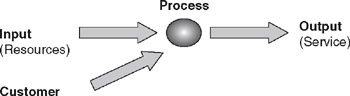
 For a service business the perceived value of the offering to the customer is determined by the service rendered rather than the product offered. The customer is close to the supplier and provides input to the process as shown in Figure 7.3. As Wright and Race (2004) say, A service organization exists to interact with customers and to satisfy customers' service requirements. For any service to be provided, there has to be a customer. Without customer input the service cannot be provided. For example, from high-level personal interaction between the provider and the customer, such as a medical consultant, down to no direct interaction with staff of the provider, such as automatic barrier entry to a car park, some input from the customer is essential as an input into the service system.
This intimacy of a customer in a service function has led to the perception that service cannot be stored and has to be produced and consumed simultaneously. Of course, there are some services that have to be produced at the delivery point, such as emergency medical treatment. However, in a higher proportion of services the activities that can be isolated from the interaction of the customer are uncoupled from the organization. The isolated operations can be managed using the similar methods used in manufacturing operations. The examples of these types of services include tailors, banks and hotels. Whether it is a small-scale or a large-scale operation, all services can be grouped as...