UNIX for OpenVMS Users, Third Edition
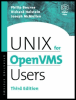
This book makes it easier to see what OpenVMS and UNIX have in common, and to take one s knowledge and experience in OpenVMS over to the brave new world of UNIX.
 TABLE OF CONTENTS
 One half of the world cannot understand the pleasures of the other.
Jane Austen
Now that you are familiar with enough file-management commands to perform simple tasks, we turn to the next major hurdle in mastering a new operating system: the editor. What alternatives does UNIX offer to the OpenVMS user familiar with EDT, TPU, or EVE? As you might expect, the alternatives are many and varied. The editors edit, ed, ex, Emacs, and vi provide interactive editing; sed provides noninteractive editing; and awk, a more sophisticated, hence more complex, noninteractive editor, provides pattern matching and subsequent file modification useful for extensive file reformatting.
These seven "standard" editors provided in UNIX represent only the tip of the editing iceberg, as you might guess from the chapter quote. There are dozens of text editors available as freeware, shareware, and commercial products.
To the new UNIX user, this chapter may appear to cover a bewildering amount of material. Most readers will feel more comfortable concentrating on a subset of commonly used ex and vi commands, leaving sed and awk for later. This is entirely appropriate, as sed and awk are meant for whole-file manipulation, more in the manner of programming languages. You need only become familiar with one editor, which you can do only with practice, to move on to subsequent chapters. The user who is ready to develop an application may return to sed and awk