VB.NET Developer's Guide

Teaches Visual Basic programmers all about Microsoft s .NET platform, and how to develop applications using the new Visual Basic.NET.
 TABLE OF CONTENTS
 As part of the .NET Framework, all .NET applications will execute using the same runtime environment. This is referred to as the Common Language Runtime (CLR). It is the driving force behind putting Visual Basic on the same footing as Visual C++, for example, as a powerful object-oriented language. The CLR will improve performance and ease the usage of components created in different languages via cross-language integration.
The CLR controls or manages the execution of a program. When you develop code using VB.NET, the code will be compiled for use under the control of the CLR. This is called managed code. This allows your code to take full advantage of the .NET Framework. If you develop code with previous versions of Visual Basic, you will create unmanaged code. It will not be able to utilize the power and benefits that the CLR brings.
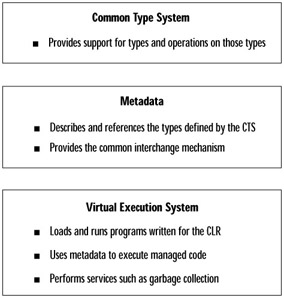
The CLR (see Figure 4.1) is the heart of the .NET platform. The CLR offers such a radical change from the old runtimes, it is no wonder that .NET is often referred to as a revolution, and not an evolution, of the current Visual Studio development platform. It introduces a whole slew of new and exciting features for developers. In this chapter, we discuss some of the fantastic features of the .NET platform and the vital role the CLR plays in implementing them, including the following: