VB.NET Developer's Guide
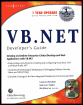
Teaches Visual Basic programmers all about Microsoft s .NET platform, and how to develop applications using the new Visual Basic.NET.
 TABLE OF CONTENTS
 Even though this book is focused on the intermediate programmer, some fundamental programming is included. This can be used as a refresher, or for those of you from different programming languages, it will provide you the syntax for some fundamental programming. This chapter is not intended to teach beginners how to program. We cover how variables are declared and used. Variable types have changed since Visual Basic 6.0. You must be more specific with data types now. You cannot count on Visual Basic to automatically convert everything for you. Also new to Visual Basic .NET are structures. If you have programmed in C, this will be familiar. This replaces the Type in previous versions of Visual Basic. Structures allow you to logically group together variables of different (or same) data types. Each member of a structure is given a name. It allows you to utilize a group of data as a single unit with access to its members by name.
When developing applications, you have to be able to dynamically set the flow of a program s execution. There are several programming fundamentals to allow you to control the flow of execution. This chapter shows you the syntax and usage for decision making and looping. Arrays allow you to store data that can be accessed by indexes rather than names. Arrays have changed somewhat from previous versions, and it is important to understand these differences. Functions allow you to separate code into units of functionality. There are many benefits to...