Many different types of users have benefited from video transport technology. Let's look at some familiar and some not-so-familiar applications. In this chapter, we will discuss some interesting ways in which people have had success with video transport.
ENTERTAINMENT
Lots of people use television solely as a means of entertainment. This multi-billion dollar industry depends on efficient, reliable video transport for many functions. First, let's look at the important distinction between contribution, distribution, and delivery networks in broadcast television networks (see Figure 2-1).
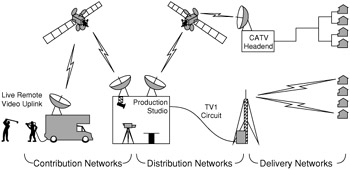 Figure 2-1: Broadcast Television Contribution, Distribution, and Delivery Networks
 Contribution networks are used to gather content that will be used in a television program. These networks are configured as many-to-one, funneling content from a variety of sources into a central location for producing a program.
Distribution networks are used to transmit finished content to various program delivery providers including over-the-air broadcasters, cable television (CATV) providers, and direct-to-home (DTH) satellite companies. These networks are usually configured as one-to-many, spreading content from a master source to tens or hundreds of delivery service providers.
Delivery networks are used to transmit content to the final viewers by many different means, including broadcast, satellite, CATV, DSL, IP, and other types of networks. [1] This transport takes place in real time, that is, delivering the same content at the same time to all viewers in a service area for immediate viewing. Delivery networks are configured as one-to-many, and the number of viewers can range from a few hundred to...


 TABLE OF CONTENTS