Wind Power Integration: Connection and System Operational Aspects

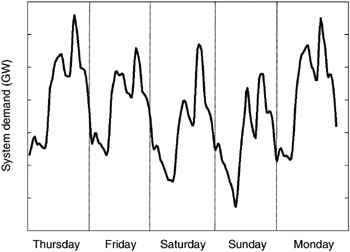
In addition to ensuring a continuous balance between electrical demand and the combined output of the system generation, the system operator must also ensure that network voltage levels and the system frequency remain within statutory limits. Clearly, this is a challenging task, made more difficult by the fact that the total power drawn by consumers of a large utility can fluctuate between wide limits, depending on seasonal weather, time of day, TV schedules, national holidays, major events, and so forth. Figure 5.1 illustrates a typical northwest European demand profile over a five-day period. Superimposed on a daily variation of high demand during daylight hours and low demand at night, it can be seen that the peak demand during weekdays is significantly higher than that at the weekend. Similarly, the late night/early morning minima are significantly lower at the weekend compared to weekdays.
Unfortunately, there can only be minimal control over load behaviour, although appropriate tariff structures, for example, can be used to encourage demand during natural periods of low demand and discourage demand during natural periods of peak demand, so that a flatter, less variable load curve is obtained. One commonly applied caveat to this statement is the use of pumped storage an upper and lower reservoir are linked by a hydraulic turbine-synchronous machine arrangement which can operate either as a (hydro) generator or a motor (pump). During periods of high demand, water is released from the upper reservoir, rotating...