EMC for Product Designers, Fourth Edition

Until the EMC Directive, most commercial immunity testing was not mandatory, but driven by customer requirements for reliability in the presence of interference. Military and aerospace immunity test standards have been in existence for some time, and were occasionally called up in commercial contracts in default of any other available or applicable standards. These allow for both conducted and radiated RF immunity test methods. The major established commercial standard tests were originally listed until the mid-90s in IEC 801. These have long since been superseded; we now have IEC 61000-4-3 third edition and IEC 61000-4-6 second edition, for radiated and conducted tests respectively. CISPR 20 requires both conducted and radiated immunity tests but applies only to broadcast receivers and related equipment.
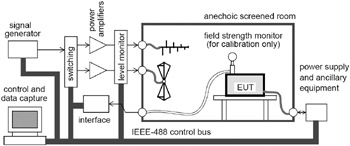
Figure 7.1 shows the components of a typical radiated immunity test system using a screened room.
The basic requirements are an RF signal source, a broadband power amplifier and a transducer. The latter may be a set of antennas, a transmission line cell or a stripline. These will enable you to generate a field at the EUT s position, but for accurate control of the field strength there must be some means to control and calibrate the level that is fed to the transducer. A test house will normally integrate these components with computer control to automate the frequency sweep and levelling functions and to meet the field calibration requirements of the standard.
Any RF signal...