EMC for Product Designers, Fourth Edition

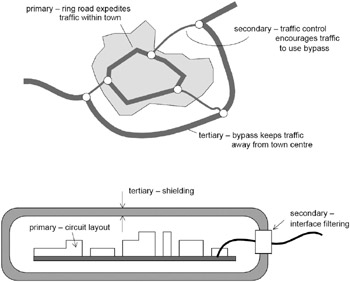
Designing for good EMC starts from the principle of controlling the flow of interference into and out of the equipment. You must assume that interference will occur to and will be generated by any product which includes active electronic devices. To improve the electromagnetic compatibility of the product you place barriers and route currents such that incoming interference is diverted or absorbed before it enters the circuit, and outgoing interference is diverted or absorbed before it leaves the circuit. A good analogy is to think of the circuit as a town, and the EMC control measures as bypasses or ring roads. The interference (traffic) is routed around the town rather than being forced to flow through it; the disruption to the town s operation is that much less.
In either case, you can conceive the control measures as applying at three levels, primary, secondary and tertiary, as shown in Figure 11.1.
Control at the primary level involves circuit design measures such as decoupling, balanced configurations, bandwidth and speed limitation, and especially board layout and grounding. For some low-performance circuits, and especially those which have no connecting cables, such measures may be sufficient in themselves. At the secondary level you must always consider the interface between the internal circuitry and external cables. This is invariably a major route for interference in both directions, and for some products (particularly where the circuit design has been frozen) all the control may have to be applied by filtering at...