Hack Proofing Linux: A Guide to Open Source Security

Excellent detailed introduction to key Linux security tools and
techniques, for non-system administrators.
 TABLE OF CONTENTS
 Thus far, you have learned how to use port scanning and monitoring devices. These applications are quite effective in determining if your server is up and running. They are perfect tools if you want to find out what type of service is listening. However, using vulnerability detection software, you can find out exactly what specific application is listening on that port. A good hacker is well informed concerning the popular servers on the Internet, and can quickly take advantage of a specific daemon that has a security problem.
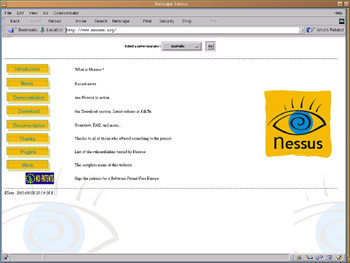
Nessus allows you to proactively scan your systems to determine its weaknesses. Nessus is comprised of a server and a client. The server runs only on Linux systems, whereas clients exist for Linux, Windows, and Macintosh systems. The Nessus home page is shown in Figure 3.26.
Although no scanner can offer you a 100-percent solution, this scanner is updated often, and is in wide use. It will scan for the following types of problems: