GMPLS: Architecture and Applications

This chapter introduces GMPLS signaling. It explains the role of signaling within a GMPLS network and defines the signaling protocol that is used to exchange messages within the control plane in order to establish LSPs within the data plane.
This chapter provides detailed coverage of GMPLS signaling concepts and interfaces, as well as the basic signaling protocol (RSVP-TE, borrowed from MPLS), and how it was extended to satisfy the needs of GMPLS.
Signaling is the process of exchanging messages within the control plane to set up, maintain, modify, and terminate data paths in the data plane. In the GMPLS context, these data paths are LSPs. The collection of signaling messages and processing rules is known as the signaling protocol.
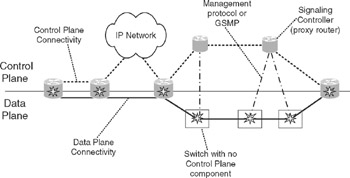
Signaling messages are exchanged between software components called signaling controllers throughout the network. Each signaling controller is responsible for managing the data plane components of one or more data switches. In GMPLS the data switches are called Label Switching Routers (LSRs) and it is usual for the signaling controller to be present on the LSR so that the whole forms a single unit within the network. However, the GMPLS architecture supports two divergences from this collocation: First, the signaling controller may be physically diverse from the data switch, with a management or control protocol used to communicate between the two; secondly, a single signaling controller may manage more than one data switch. These possibilities are shown in Figure 4.1.