GMPLS: Architecture and Applications

In this section we will discuss service recovery on the path level that is, recovery of entire LSPs (end-to-end recovery) or individual segments of LSPs (segment recovery and fast re-route). We will start by introducing the notion of the path recovery domain, because it is important for all types of path level recovery. After that we will discuss in detail end-to-end path recovery, segment recovery, and the fast re-route technique.
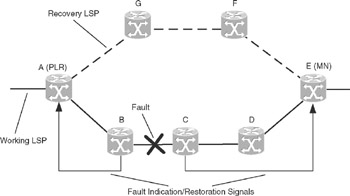
Consider the fragment of a network depicted in Figure 7.3. Assume that a working LSP of some protected service goes through nodes A-B-C-D-E. A path recovery domain for the service could be defined as a part of the network where some scheme is provisioned to recover the service from failures of a segment of one of the service's LSPs (normally a working LSP, but protecting LSPs can also be protected). In the end-to-end path recovery model, the recovery domain covers the entire protected LSP. In case of path segment recovery, the protected LSP spans multiple recovery domains, which, generally speaking, may overlap, nest one within another, and so forth. It is reasonable to think of end-to-end path recovery as a special case of path segment recovery, where the protected segment is the entire LSP.
Figure 7.3 shows a recovery domain. It provides recovery from any fault that might happen on the segment A-B-C-D-E. The LSP going through nodes A-G-F-E is called a recovery LSP. This is...