GMPLS: Architecture and Applications

7.6: Span Recovery

7.6 Span Recovery

In the context of this chapter, the term recovery usually means both protection and restoration. However, at the time this book was written, link-level (span) restoration was neither standardized nor deployed. Therefore, in this section the terms span recovery and span protection are used interchangeably.

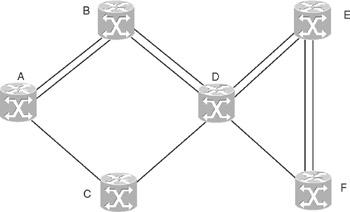
A service that takes path A-B-D-E-F in the network depicted in Figure 7.1 can be provisioned as span protected. This is because each pair of adjacent nodes along the path is interconnected with two parallel links, so that one of them can protect the other. The following schemes of span protection are defined.

  • Dedicated unidirectional 1 + 1

  • Dedicated bidirectional 1 + 1

  • Dedicated 1:1 with extra traffic

  • Shared M:N

  • Enhanced


Figure 7.1: Span protection.

Each span protection scheme requires a consistent view of the association of protected and protecting spans for every link. The GMPLS Link Management Protocol (LMP) and/or local configuration should satisfy this requirement.

7.6.1 Dedicated Unidirectional 1 + 1 Span Protection

In this scheme a TE link contains at least two parallel spans, and for every working span there is a dedicated protecting span. All traffic traversing the link is permanently bridged onto both spans on one side of the link, and is selected from one of the spans on the other side (usually from one that has a better quality signal). When the selection function detects a failure, it autonomously starts receiving data from the other span. Similarly, when the failure is restored, the...

UNLIMITED FREE
ACCESS
TO THE WORLD'S BEST IDEAS

SUBMIT
Already a GlobalSpec user? Log in.

This is embarrasing...

An error occurred while processing the form. Please try again in a few minutes.

Customize Your GlobalSpec Experience

Category: Modular and Prefabricated Bridges
Finish!
Privacy Policy

This is embarrasing...

An error occurred while processing the form. Please try again in a few minutes.