Local Access Network Technologies

This text reviews the major new access technologies that are finding their way into significant use. It defines terms and technologies, and goes on to discuss how those technologies may be deployed.
 TABLE OF CONTENTS
 The DSL technology works by exploiting the existing copper access network between the customer's telephone socket and the local exchange (see Figure 5.2). Because this infrastructure already exists to support telephony, it only requires the addition of equipment at both ends of this link to upgrade the telephone line into a high-speed data link.
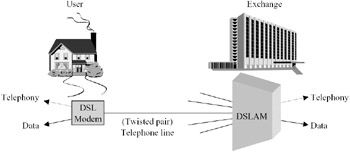
There are a number of flavours of DSL available but the principle flavour now being deployed is ADSL (asymmetric digital subscriber line). It is called asymmetric because of the difference in capacity of the upstream and downstream channels the upstream channel being of lower capacity than the downstream. The ADSL technology is well described in other articles [3,4].
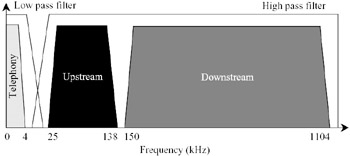
The ADSL technology that enables this upgrade is similar to the modem technology used on 28 and 56 k dial-up modems. There is, however, one major difference in that the coding is not constrained to fit within the normal voice bandwidth. Indeed, it starts above the voice spectrum (4 kHz) and continues up to 1 MHz. The way in which the bandwidth is allocated between the voice channel, and the upstream and downstream channels is shown in Figure 5.3. The technology and spectrum allocated is described in more detail in Chapter 4.
The fact that the ADSL coding is not constrained to fit within the normal voice channel means that the data channel can be used at the same time as a...